
Biotin in Eggs: Raw vs Cooked (Avidin, Absorption & Availability)
When I started searching for biotin sources to grow my hair healthy and strong, eggs were at the top of my list. But what was the shocking truth I learned: the way the eggs are prepared directly affects how much biotin your body can actually absorb. If you are consuming eggs for biotin, the cooking method matters the most. Let’s dive into the research that I have compiled for biotin in eggs, raw vs cooked.
Quick Answer: Raw egg whites contain avidin, which binds biotin and prevents absorption. Cooking denatures avidin, so biotin becomes available. NIH ODS lists 10 mcg biotin in 1 whole cooked egg (33% DV).
Biotin availability: Raw vs Cooked eggs (avidin explained)
Raw and cooked eggs can contain biotin, but your body absorbs it very differently depending on how the egg is prepared. The key reason is avidin, a protein found in raw egg whites.
“Dietary avidin, a glycoprotein in raw egg whites, binds tightly to dietary biotin and prevents biotin’s absorption…”
This is why cooked eggs win: heat changes avidin’s structure (it denatures it), so it can’t bind biotin the same way. In simple terms, cooking makes biotin more available for absorption, especially when the whites are fully set (not translucent/runny).
Source: NIH Office of Dietary Supplements (ODS) — Biotin Fact Sheet (Health Professional)
Biotin content in 1 large cooked egg (mcg)
Biotin content in 1 large cooked egg (mcg)
- 1 whole cooked egg: 10.0 mcg biotin (about 33% of the Daily Value)
- Adult Daily Value (DV): 30 mcg/day (adults and children age 4+)
Source: NIH Office of Dietary Supplements (ODS) — Biotin Fact Sheet (Health Professional)
What Is Biotin and How Much Biotin Per Day Do You Need?
Biotin, also known as vitamin B7 or vitamin H, is a water-soluble vitamin that plays a crucial role in converting food into energy. This essential nutrient supports healthy hair growth, maintains skin integrity, strengthens nails, and helps your body metabolize carbohydrates, fats, and proteins effectively.
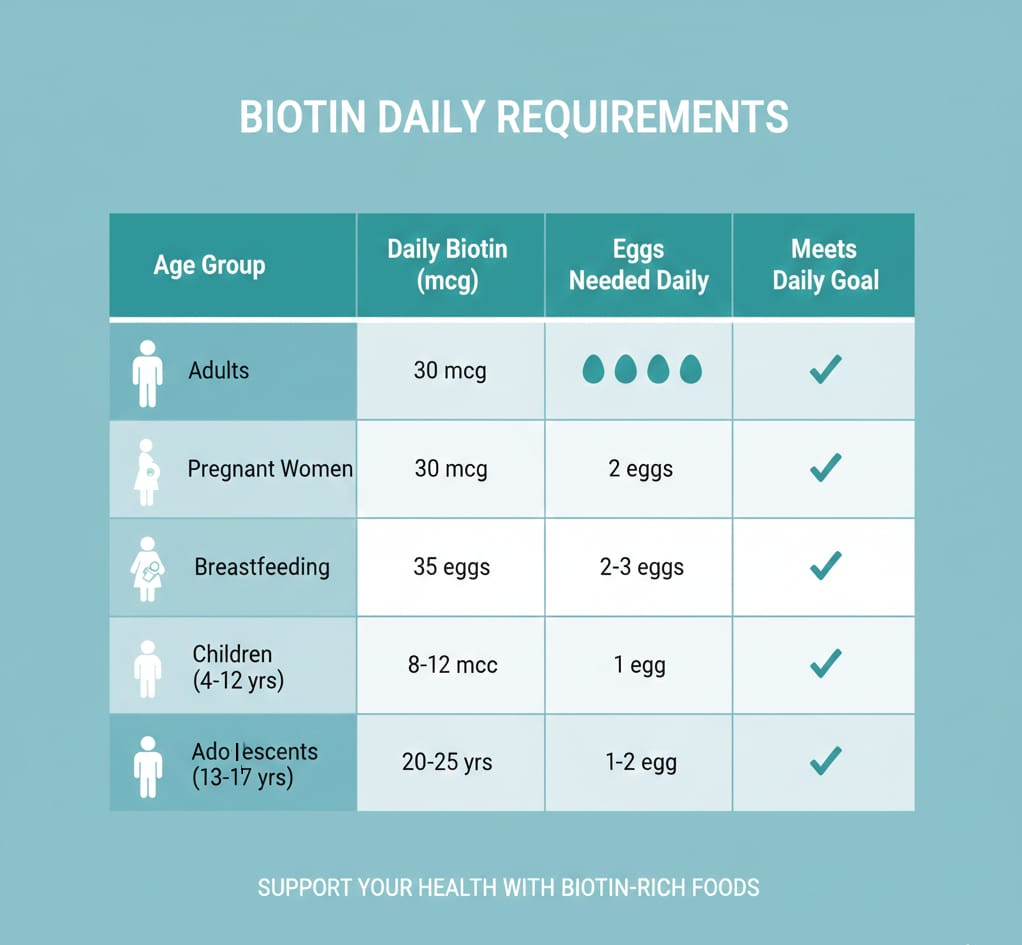
The recommended daily biotin intake varies by age and life stage:
| Life Stage | Daily Biotin Requirement |
| Adults (men & women) | 30 mcg |
| Pregnant women | 30 mcg |
| Breastfeeding women | 35 mcg |
| Children (1-8 years) | 8-12 mcg |
| Adolescents (9-18 years) | 20-25 mcg |
According to the National Institutes of Health Office of Dietary Supplements, doses up to 10,000 mcg of biotin daily are generally safe with no reported toxicity. However, getting biotin from whole food sources like eggs is always preferable to mega-dose supplements.
Eggs stand out as a biotin powerhouse, with each whole egg providing a significant portion of your daily needs in a highly absorbable form when prepared correctly.
Read in detail in this blog
How Much Biotin Should I Take Daily? Complete Dosage Guide
Biotin in Eggs Raw vs Cooked: The Critical Difference
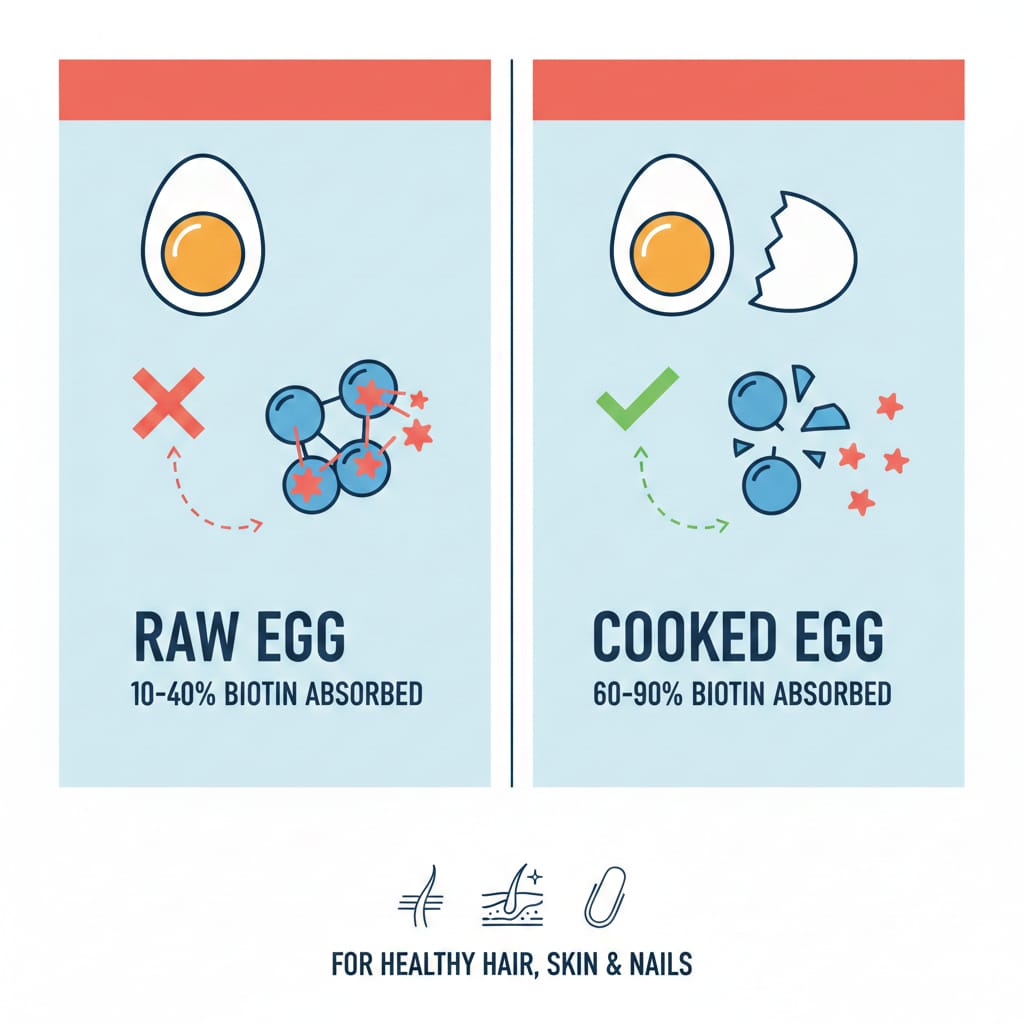
A single whole egg contains between 10-25 mcg of biotin, with most of this precious nutrient concentrated in the yolk at approximately 7.8-10 mcg per yolk. This means one egg can provide 25-33% of your daily biotin requirement, making eggs an exceptional dietary source.
Here’s where things get interesting: both raw and cooked eggs contain the same amount of biotin, but your body’s ability to absorb that biotin differs dramatically based on preparation method. The key factor is a protein called avidin found in raw egg whites.
When eggs remain raw, avidin binds tightly to biotin and prevents your digestive system from absorbing this vital nutrient. Cooking changes everything by denaturing the avidin structure, freeing the biotin for absorption.
Understanding this difference is crucial if you’re consuming eggs to support hair health or overall wellness.
The Avidin Problem: Why Raw Egg Whites Block Biotin
Avidin is a glycoprotein found in raw egg whites that has an extraordinarily strong affinity for biotin. This binding occurs in your digestive system and effectively makes the biotin unavailable for metabolic use. The biotin passes through your system without providing any nutritional benefit.
Key facts about avidin:
- Found only in raw egg whites, not cooked
- Represents only 0.05% of the total egg white protein
- Binds biotin with extreme strength (dissociation constant of approximately 10⁻¹⁵ M, one of the strongest non-covalent interactions known in nature)
- Gets destroyed by heat during cooking
- Exists as a natural antimicrobial defense in eggs
This avidin issue is particularly important for people seeking dietary biotin to support their hair health. If you’re consuming raw eggs thinking you’re maximizing biotin intake, you’re actually doing the opposite—you’re blocking the very nutrient you’re trying to obtain.
Does Cooking Eggs Destroy Biotin?
No, cooking does not destroy biotin. Biotin is relatively heat-stable and remains intact even at typical cooking temperatures.
What cooking destroys is avidin. Heat causes the avidin protein to denature, meaning its three-dimensional structure unfolds and loses its ability to bind biotin.
Temperature effects on avidin:
- 70°C (158°F): Avidin starts to denature
- 85°C (185°F): Extensive avidin breakdown
- 100°C (212°F): Nearly complete avidin destruction
The biotin molecule itself tolerates heat well and survives the cooking process with minimal degradation. This means the biotin content in your egg yolk remains essentially unchanged whether the egg is raw or cooked.
This is excellent news because it means you can enjoy cooked eggs in any form—fried, scrambled, boiled, or poached—without worrying about losing biotin content.
In fact, cooking actually improves biotin availability by 60-90% compared to raw eggs, making cooked eggs far superior for meeting your biotin needs.
Best Cooking Methods for Maximum Biotin Absorption
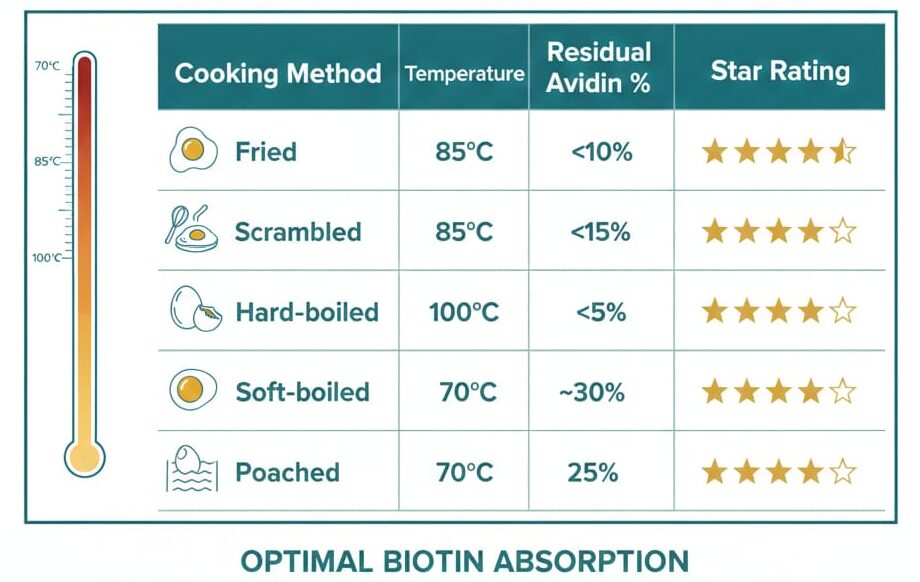
Not all cooking methods are equally effective at denaturing avidin. Research examining residual avidin activity after various cooking methods reveals interesting differences in how thoroughly each method breaks down this biotin-blocking protein.
| Cooking Method | Residual Avidin Activity | Biotin Availability |
| Fried eggs | 33% | ⭐⭐⭐⭐⭐ Best |
| Scrambled eggs | 33-40% | ⭐⭐⭐⭐⭐ Excellent |
| Hard-boiled (10+ min) | <30% | ⭐⭐⭐⭐⭐ Excellent |
| Soft-boiled (2 min) | 40% | ⭐⭐⭐⭐ Good |
| Poached eggs | 71% | ⭐⭐⭐ Fair |
Fried eggs emerge as the winner with only 33% residual avidin activity remaining after cooking. This means frying denatures approximately 67% of the avidin, allowing significantly better biotin absorption.
Why do these differences exist?
- Cooking time matters more than cooking method
- Longer cooking = better avidin denaturation
- “Cold spots” in egg white retain more avidin
- Direct heat contact breaks down avidin faster
- Stirring ensures even heat distribution
For optimal biotin absorption when using eggs to support hair and overall health, choose frying or scrambling as your cooking method, and always ensure egg whites are fully set and no longer translucent.
Can Raw Eggs Cause Biotin Deficiency?
The short answer is yes, but only under extreme circumstances that most people will never encounter. Developing biotin deficiency from raw eggs requires consuming massive quantities, typically 24 or more raw egg whites daily for several months.
- A woman consumed 6 raw eggs daily for 18 months → developed a deficiency
- Bodybuilders eating 5-8 raw egg whites daily → showed deficiency symptoms
- Case studies dating back to the 1940s confirmed avidin-induced deficiency
Symptoms of biotin deficiency include:
- Progressive hair loss and brittle nails
- Scaly red dermatitis (especially around eyes, nose, mouth)
- Persistent fatigue and depression
- Muscle pain and weakness
- Digestive issues and nausea
- Acne-like skin breakouts
- Numbness or tingling in extremities
Some individuals also experience acne-like skin breakouts, which relates to concerns about biotin and acne-prone skin. For the average person eating 1-2 eggs daily, biotin deficiency from eggs is not a realistic concern, especially if those eggs are cooked.
Here’s a detailed guide about
Biotin Deficiency in Vegans : Signs, Sources & Prevention Guide
Is Biotin in Egg Yolk or Egg White?
Almost all the biotin in an egg is concentrated in the yolk, not the white.
Each egg yolk contains approximately 7.8-10 mcg of biotin, while the egg white contains essentially no biotin—only the avidin protein that blocks biotin absorption.
Biotin distribution in eggs:
| Egg Component | Biotin Content | Avidin Content |
| Egg yolk | 7.8-10 mcg | None |
| Egg white | 0 mcg | High (0.05% of protein) |
| Whole egg | 10-25 mcg | Present in white only |
Egg white-only diets provide no biotin benefit and can actually interfere with biotin absorption if other biotin sources are present in your meal. The egg yolk’s biotin content is nature’s clever solution to the avidin problem.
This natural balance makes whole eggs particularly effective for obtaining dietary biotin. For anyone seeking biotin benefits from eggs, the key takeaway is simple: always eat whole eggs, not just egg whites.
Best Time of Day to Take Biotin from Eggs
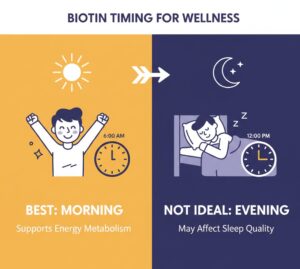
Timing can influence how effectively your body absorbs and utilizes biotin from eggs. Should I take biotin in the morning or at night?
Research and metabolic science suggest that morning consumption offers several advantages. Biotin plays a key role in energy metabolism, helping convert carbohydrates, fats, and proteins into usable energy. These metabolic processes are more active during waking hours when your body needs fuel for daily activities.
Optimal timing for biotin from eggs:
- ⏰ Morning (6-9 AM): Best for energy metabolism support
- 🍳 With breakfast: Enhanced absorption on a lighter stomach
- 💪 Pre-workout: Supports energy production during exercise
- 🌙 Avoid evening: May interfere with sleep in sensitive individuals
Biotin and Acne Prone Skin: What Egg Eaters Should Know
Biotin itself doesn’t directly cause acne. However, high-dose biotin supplements—typically 5,000-10,000 mcg daily—have been associated with acne breakouts in some individuals.
When high biotin doses reduce B5 absorption, some people experience skin issues, including acne-like breakouts.
Biotin and acne: dosage matters
| Biotin Source | Daily Amount | Acne Risk |
| 1-2 eggs | 10-50 mcg | ✅ Very low risk |
| Food sources | 30-100 mcg | ✅ Low risk |
| Supplements (1,000 mcg) | 1,000 mcg | ⚠️ Low-moderate risk |
| Supplements (5,000+ mcg) | 5,000-10,000 mcg | ❌ Higher risk |
Here’s the good news for egg consumers: eggs contain moderate biotin amounts of 10-25 mcg per egg. This natural, food-based biotin amount is generally safe even for those with sensitive, acne-prone skin.
Guidelines for acne-prone individuals:
- Natural food sources (eggs) are safer than supplements
- 1-2 eggs daily unlikely to cause skin problems
- Stay well-hydrated for optimal biotin metabolism
- Avoid mega-dose supplements (5,000+ mcg)
- Monitor skin response when increasing egg intake
- Consider B5 supplementation if taking high-dose biotin
Natural Sources of Biotin for Hair: Why Eggs Are Superior
When comparing various dietary biotin sources for supporting hair growth, eggs stand out as one of the most practical and effective options. Let’s examine how eggs compare to other biotin-rich foods.
| Food Source | Serving Size | Biotin Content | % Daily Value |
| Beef liver | 3 oz (85g) | 31 mcg | 103% |
| Whole egg (cooked) | 1 large egg | 10-25 mcg | 33-83% |
| Salmon | 3 oz (85g) | 5 mcg | 17% |
| Sweet potato | ½ cup | 2.4 mcg | 8% |
| Almonds | ¼ cup | 1.5 mcg | 5% |
| Spinach | ½ cup cooked | 0.5 mcg | 2% |
Why cooked eggs excel as a biotin source:
- 💰 Affordable and universally available
- ⚡ High bioavailability when properly cooked
- 🥚 Complete protein with all essential amino acids
- 🧬 Contains sulfur for keratin production
- 🍳 Versatile and easy to incorporate daily
- 📊 25-33% of daily biotin needs per egg
- ⏱️ Quick to prepare (3-5 minutes)
For optimal hair growth support, consume 1-2 cooked eggs daily as part of a balanced diet rich in various nutrients. While biotin is important for hair health, it works synergistically with other nutrients like protein, iron, zinc, and vitamins A, C, D, and E.
How to Maximize Biotin Absorption from Eggs
To get the most biotin benefit from your eggs, follow these evidence-based practices that optimize both biotin content and absorption.
Cooking best practices:
- ✅ Always cook eggs thoroughly – never eat raw egg whites regularly
- ✅ Eat whole eggs – yolk contains all the biotin
- ✅ Choose frying or scrambling – lowest residual avidin (33%)
- ✅ Cook whites until fully set – no translucency
- ✅ Use medium-high heat – ensures avidin denaturation
- ✅ Cook for 3-4 minutes minimum – adequate heat exposure
- 💧 Stay hydrated – supports biotin metabolism
- 🚫 Avoid egg white-only meals – eliminates biotin source
Daily intake recommendations:
- 1 egg daily = 33-83% of biotin needs
- 2 eggs daily = 66-166% of biotin needs (safe, no upper limit)
- Combine with other biotin sources for optimal intake
Frequently Asked Questions
How much biotin per day should I get from eggs?
One to two cooked eggs daily provides 10-50 mcg of biotin, meeting 33-100% of your daily needs (30 mcg for adults). This amount is safe and effective for supporting hair, skin, and nail health.
Do cooked eggs have more biotin than raw eggs?
No, both contain the same biotin amount (10-25 mcg), but cooked eggs allow better absorption. Cooking destroys avidin that blocks biotin, making the vitamin 60-90% more bioavailable to your body compared to raw eggs.
What’s the best time of day to take biotin from eggs?
Morning is optimal because biotin supports energy metabolism and works better during active hours. Eating cooked eggs at breakfast provides sustained energy and maximizes absorption on an empty or lightly filled stomach.
How much biotin is safe to take from food and supplements combined?
Up to 10,000 mcg of biotin daily is considered safe with no known toxicity. However, food sources like eggs (10-25 mcg per egg) are preferable to mega-dose supplements, especially for those with acne-prone skin.
Can biotin from eggs cause acne breakouts?
Moderate egg consumption (1-2 daily) is unlikely to cause acne. Eggs contain reasonable biotin amounts (10-25 mcg). High-dose supplements (5,000+ mcg) are more likely to trigger breakouts in sensitive individuals, not whole food sources.
Should I take biotin in the morning or at night for hair growth?
Morning is better for biotin-rich foods like eggs because biotin supports energy production and metabolic processes that are more active during daytime hours. Consistency matters more than timing for hair growth results.
Are eggs the best natural sources of biotin for hair?
Eggs are among the best as they are affordable, accessible, and highly bioavailable when cooked. One egg provides 25-33% of daily biotin needs plus complete protein and sulfur, both essential for healthy hair growth.
How long should I cook eggs for optimal biotin absorption?
Cook until egg whites are fully set and no longer translucent. Frying for 3-4 minutes or boiling for 6-8 minutes ensures avidin is denatured while preserving all biotin content in the yolk.
Conclusion
Understanding biotin in eggs raw vs cooked reveals a clear winner: cooked eggs are vastly superior for biotin absorption. While both raw and cooked eggs contain the same biotin amount, cooking doesn’t destroy biotin; it actually improves absorption by 60-90%.
For optimal results, remember that how much biotin per day you need (30 mcg for adults) can be met with just 1-2 cooked eggs, providing 33-100% of your daily requirement.
The best time of day to take biotin from eggs is morning, when your metabolism is most active and ready to utilize this energy-supporting vitamin.
Always consume whole eggs to get the biotin-rich yolk, and eat them regularly as one of the most accessible dietary sources to support hair, skin, and nail health.
Related Read
Biotin vs Collagen: Which is Better for Hair & Nails?
Do Biotin Gummies Actually Work? Pills vs Gummies Compared
Medical Disclaimer: This content is for informational purposes only and is not intended as medical advice. Consult your healthcare provider before making significant dietary changes or if you suspect a biotin deficiency.
About the Author
Hi, I’m Saima Hussain, founder of WellInfinity, where I bridge the gap between complex nutritional science and everyday wellness. While I’m a passionate health researcher and writer (not a medical professional), all WellInfinity content is thoroughly researched using peer-reviewed studies and cross-referenced with credible sources including the NIH, medical journals, and expert publications. When possible, articles are reviewed by registered dietitians and healthcare professionals to ensure accuracy. My mission is to empower women with reliable, science-backed information to support their health journeys.