
Glycolic vs Azelaic vs Kojic Acid: Complete Guide 2026
Not all acids work the same way. Glycolic acid vs azelaic acid vs kojic acid represent three fundamentally different approaches to treating dark spots, and understanding these differences is crucial for getting real result.
Studies on glycolic acid versus azelaic acid for melasma found no significant difference in efficacy between 12% glycolic acid and 20% azelaic acid, though their mechanisms and side effect profiles differed considerably PubMed Central.
This guide cuts through the confusion with science-backed comparisons. You’ll learn exactly how each acid works, which one targets your specific concern most effectively, and how to choose based on your skin type, sensitivity, and goals.
I’ve already written detailed guides on glycolic acid for hyperpigmentation, azelaic acid complete guide, and kojic acid for melasma. This comparison brings them all together, helping you make an informed decision without wasting time or money on products that won’t work for your skin.
Let’s find your perfect match.
Understanding How Each Acid Works
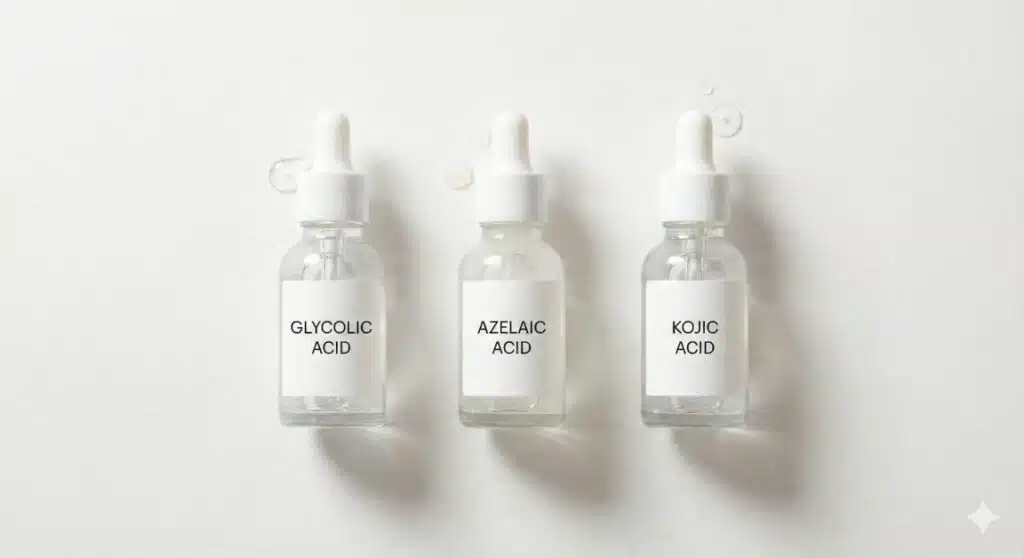
Before comparing which acid suits your needs, you need to understand their fundamental differences. These three acids tackle hyperpigmentation through completely different mechanisms.
Glycolic Acid: The Surface Exfoliator
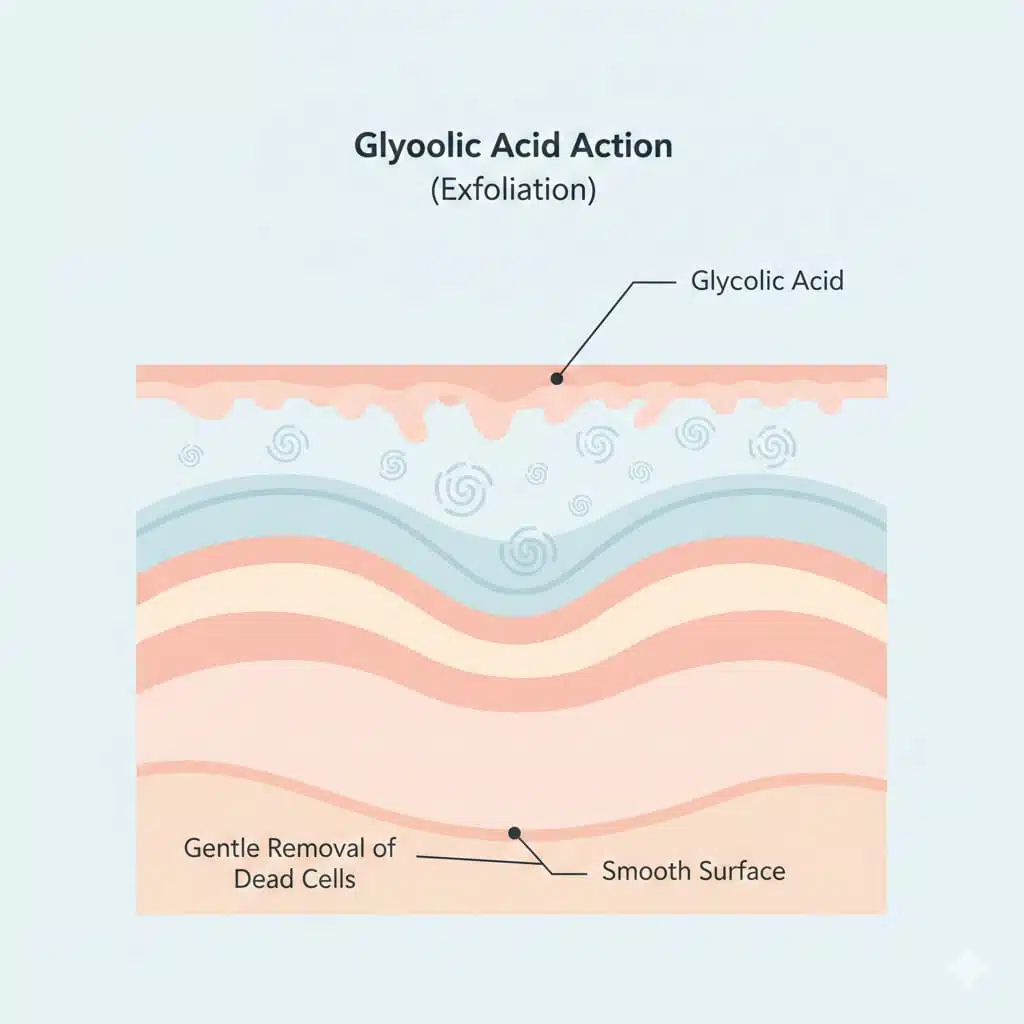
Glycolic acid works primarily by dissolving the connections between dead skin cells, causing these cells to shed more quickly and revealing healthier, less pigmented cells underneath DrugBank. As the smallest alpha hydroxy acid (AHA), its tiny molecular size allows deep penetration into the skin.
By penetrating deeply into the skin, glycolic acid inhibits the overproduction of melanin and regulates the action of melanocytes to prevent the pigments responsible for spots from marking the skin Fisher Scientific.
Key mechanisms:
- Exfoliates pigmented surface cells through chemical dissolution
- Accelerates cell turnover (bringing fresh cells to surface faster)
- Stimulates collagen production in deeper skin layers
- Reduces melanin production indirectly through exfoliation
Speed of results: 6 to 8 weeks for visible improvement
Best for: General hyperpigmentation combined with texture concerns, anti-aging, dull skin
Azelaic Acid: The Multi-Action Performer
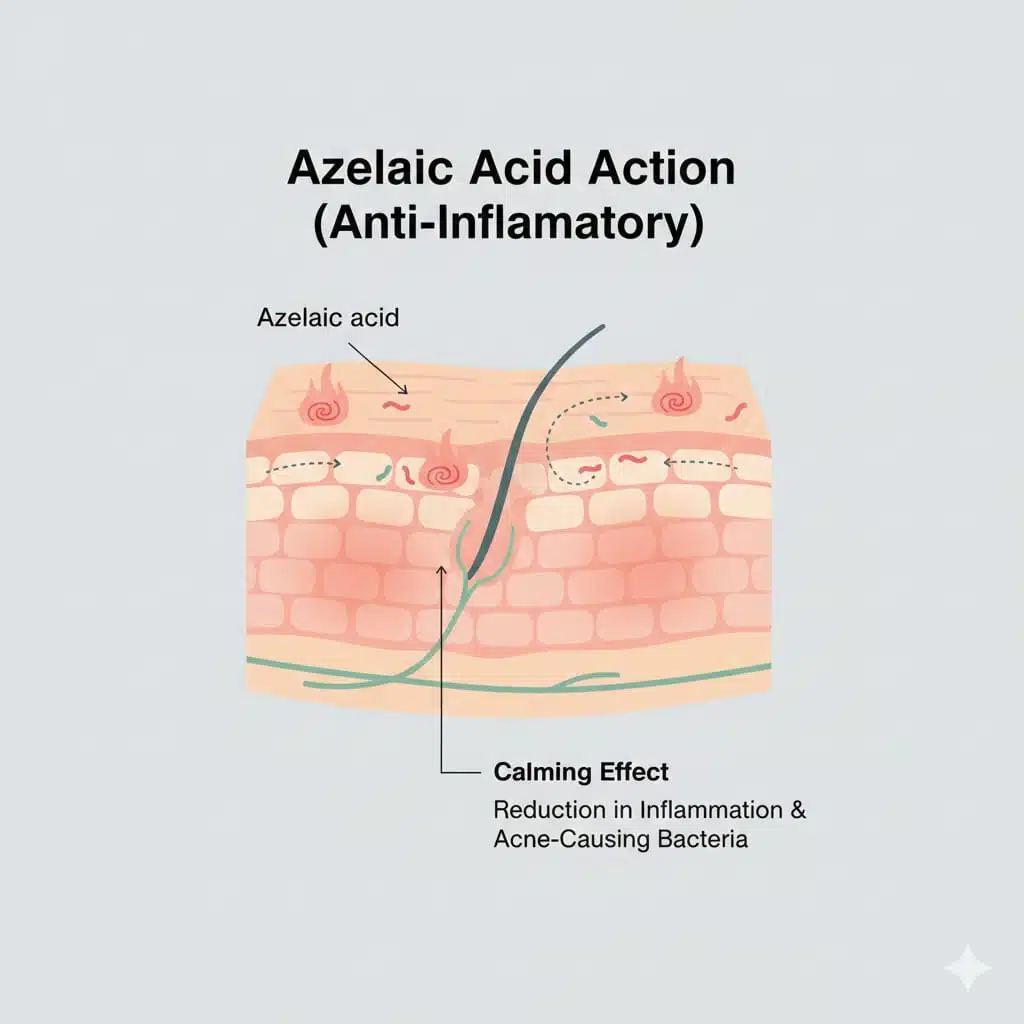
Azelaic acid acts through multiple mechanisms, including inhibiting neutrophil ROS release, interfering with inflammatory cytokine expression, reducing bacterial intracellular pH, damaging mitochondria and endoplasmic reticulum, and inhibiting DNA, protein, and tyrosinase synthesis PubMed Central.
Azelaic acid is bactericidal for Propionibacterium acnes and has demonstrable antibacterial activity against a number of other cutaneous microorganisms including S. aureus and S. epidermidis Caudalie.
Key mechanisms:
- Competitively inhibits tyrosinase (blocks melanin production)
- Kills acne-causing bacteria
- Reduces inflammation and oxidative stress
- Normalizes follicular keratinization (prevents clogged pores)
- Selectively targets abnormal melanocytes without harming normal cells
Speed of results: 8 to 12 weeks for noticeable improvement
Best for: Acne with post-inflammatory hyperpigmentation, rosacea, sensitive skin, pregnancy-safe treatment
Kojic Acid: The Melanin Blocker
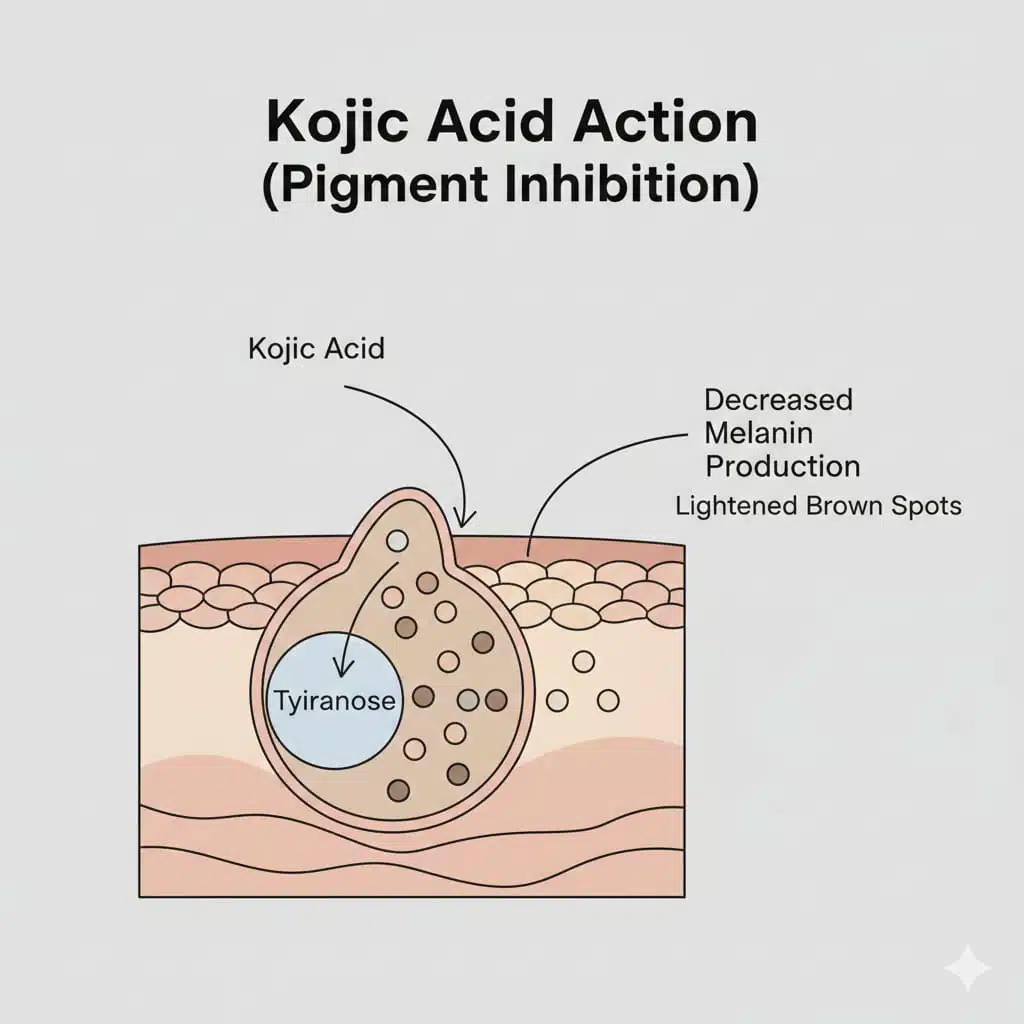
Kojic acid is the most widely used skin-whitening agent that works by chelating copper in the active site of tyrosinase, the key enzyme responsible for melanin production Dot & Key.
Kojic acid demonstrated consistent inhibitory activity on tyrosinase from mushroom and in cultured B16F10 cells, showing its effectiveness at blocking melanin synthesis at the source PubMed.
Key mechanisms:
- Directly blocks tyrosinase enzyme by binding to copper ions
- Prevents conversion of tyrosine to melanin
- Does NOT exfoliate (works below the surface)
- Antioxidant properties reduce oxidative stress that triggers pigmentation
Speed of results: 8 to 12 weeks, up to 16 weeks for melasma
Best for: Stubborn melasma, resistant hyperpigmentation, pure pigment-blocking without exfoliation
The Fundamental Difference
Glycolic acid removes pigmented cells that already exist. Azelaic acid prevents new melanin while fighting inflammation and bacteria. Kojic acid stops melanin production at its source by disabling the enzyme.
Think of it this way: glycolic acid is like removing stained tiles, azelaic acid is like preventing new stains while cleaning existing ones, and kojic acid is like turning off the machine that creates the stain in the first place.
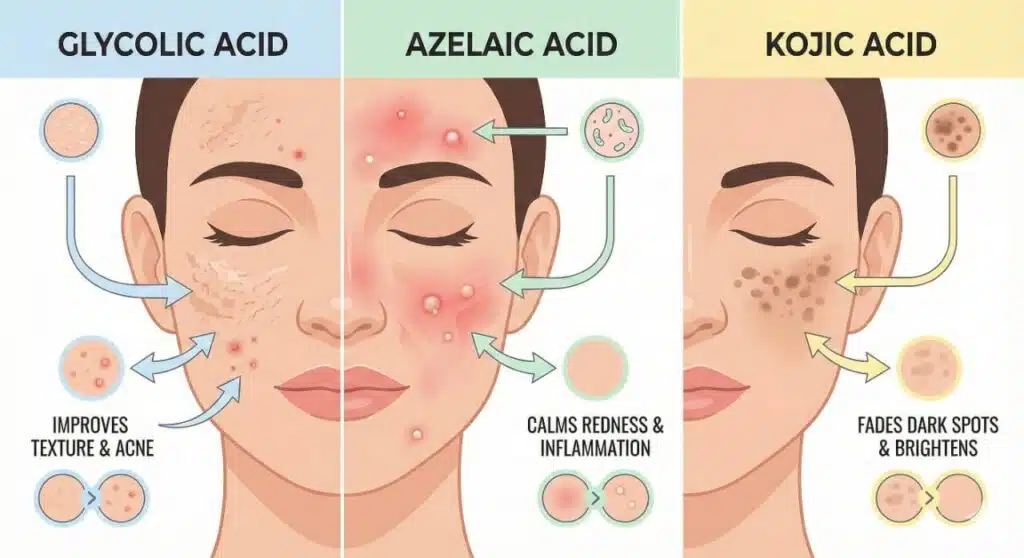
Complete Comparison Table: Glycolic vs Azelaic vs Kojic Acid
Here’s everything you need to know at a glance. This table compares all three acids across the factors that matter most when choosing your treatment.
| Feature | Glycolic Acid | Azelaic Acid | Kojic Acid |
| Type | Alpha Hydroxy Acid (AHA) | Dicarboxylic Acid | Tyrosinase Inhibitor |
| Source | Sugar cane | Grains (barley, wheat, rye) | Fermented rice, mushroom fungi |
| Primary Mechanism | Exfoliates surface cells | Multi-action (antibacterial + anti-inflammatory + melanin blocker) | Blocks tyrosinase enzyme |
| How It Works | Dissolves bonds between dead cells | Kills bacteria, normalizes cell turnover, inhibits melanin | Chelates copper in tyrosinase active site |
| Strength Level | Medium to High | Gentle to Medium | Strong |
| Best For | Texture + general hyperpigmentation + anti-aging + dullness | Acne + PIH + rosacea + sensitive skin | Stubborn melasma + resistant dark spots |
| Speed of Results | 6 to 8 weeks | 8 to 12 weeks | 8 to 12 weeks (16+ for melasma) |
| Irritation Risk | Medium to High | Very Low | High |
| Sun Sensitivity | Very High | Low | High |
| OTC Concentration | 5% to 10% | 10% | 1% to 4% |
| Rx Concentration | Up to 20% (peels) | 15% to 20% | Not typically prescribed |
| Pregnancy Safety | Low % with caution (not fully studied) | ✅ FDA Category B (safe) | ❌ Avoid (limited data) |
| Breastfeeding | Consult doctor | Generally safe | Avoid |
| Dark Skin Safety | Use with caution (risk of PIH if irritated) | ✅ Excellent (specifically studied for darker tones) | Use with caution |
| Stability | High (stable formula) | High | Low (oxidizes easily, turns brown) |
| Can Use Daily | Build up gradually | Yes, once or twice daily | Build up gradually |
| Common Side Effects | Dryness, redness, peeling | Mild tingling, temporary dryness | Burning, irritation, redness |
| Works Well With | Niacinamide, hyaluronic acid, peptides | Niacinamide, vitamin C, kojic acid | Vitamin C, niacinamide, glycolic acid |
| Avoid Mixing With | Retinol (same routine), other strong acids | Generally compatible with most | Retinol (same routine), multiple acids |
| Price (Pakistan) | Rs. 500 to Rs. 2,000 | Rs. 800 to Rs. 2,500 | Rs. 650 to Rs. 3,600 |
| Availability | Widely available OTC | OTC + prescription options | Widely available OTC (soaps, serums) |
Detailed Breakdown of Each Acid
Now that you understand the basics, let’s dive deeper into who benefits most from each acid and when to choose one over the others.
Glycolic Acid: The Fast-Acting Exfoliator
Patients with oily skin often benefit from glycolic acid toners or pads, while dry skin types may prefer creams or masks, and sensitive skin should begin with milder acid serums or alternate with lactic acids ScienceDirect.
Glycolic acid can be used on all skin types, including dry, sensitive, and oily skin, though individuals with sensitive skin should use it with caution and start with a lower concentration PubChem.
How it delivers results:
Glycolic acid works faster than most other brightening agents because it physically removes pigmented cells rather than just blocking future production. It is an effective exfoliator, useful in treatments of various kinds of hyperpigmentation, acne treatments, small bumps on the face such as keratosis pilaris, and sun damaged skin Medical News Today.
Best candidates for glycolic acid:
- People seeking multi-benefit treatment (texture plus pigmentation plus anti-aging)
- Those with dull, rough skin that needs surface renewal
- Anyone dealing with both fine lines and dark spots simultaneously
- Oily or combination skin types that can handle regular exfoliation
- People who want visible results within 6 to 8 weeks
Not ideal for:
- Very sensitive skin or active rosacea
- Those who cannot commit to daily SPF 50+ application
- People seeking purely melanin-blocking treatment without exfoliation
Azelaic Acid: The Gentle Multi-Tasker
Azelaic acid is milder than other acne-fighting ingredients like salicylic acid and adapalene, which makes it more suitable for those with sensitive skin, acne and rosacea, and it’s one of the only pregnancy-safe acne treatments on the market WebMD.
How it delivers results:
Unlike glycolic acid’s single-action exfoliation, azelaic acid works through multiple pathways simultaneously. It reduces inflammation, evens skin tone by decreasing pigmentation through tyrosinase inhibition, and fights acne by killing bacteria on your skin that cause acne Paula’s Choice.
Best candidates for azelaic acid:
- Pregnant or breastfeeding women (FDA Category B safe)
- People with sensitive skin, rosacea, or eczema
- Those dealing with both active acne and post-acne dark spots
- Anyone who has tried stronger acids and experienced irritation
- Dark skin tones prone to post-inflammatory hyperpigmentation
- People seeking gentle, steady improvement over 8 to 12 weeks
Not ideal for:
- Those wanting fastest possible results (it works slower than glycolic acid)
- People with only texture concerns and no inflammation or pigmentation
- Anyone impatient with gradual improvement timelines
Azelaic acid is central to clinical work, forming the backbone of maintenance acne regimes and is widely useful when tackling sensitive skin concerns including rosacea and perioral dermatitis L’Oréal Paris.
Kojic Acid: The Melanin-Blocking Specialist
Typical patients seeking melasma therapies with kojic acid are women who are interested in achieving their best look, and patients who seek newer melasma treatments such as kojic acid are usually those who have tried classic melasma treatments with limited improvement PubMed.
How it delivers results:
Kojic acid targets pigmentation at its source by directly blocking the tyrosinase enzyme. In a study of 40 Chinese women with epidermal melasma, the addition of 2% kojic acid to a gel containing glycolic acid and hydroquinone showed that more than half of the melasma cleared in 60% of patients receiving kojic acid compared to 47.5% without it, with complete clearance achieved in 2 patients only on the kojic acid side Admire My Skin.
Best candidates for kojic acid:
- People with stubborn melasma that hasn’t responded to gentler treatments
- Those with hormonal hyperpigmentation (pregnancy mask, birth control related)
- Anyone dealing with deep, resistant post-inflammatory hyperpigmentation
- People willing to tolerate higher irritation for stronger melanin-blocking
- Those seeking pure pigment treatment without exfoliation side effects
- South Asian, Hispanic, and African skin tones with persistent melasma
Not ideal for:
- Pregnant or breastfeeding women (limited safety data, avoid use)
- Very sensitive skin that reacts to everything
- People who want multi-benefit treatment (kojic acid focuses purely on pigmentation)
- Those with active rosacea or compromised skin barriers
- Anyone unable to commit to SPF 50+ daily with frequent reapplication
Kojic acid is considered a second-line treatment that can help lighten melasma when other methods do not improve this condition, and if a patient has shown low tolerance to other treatments, kojic acid may be a suitable alternative with comparable results Typology.
Head-to-Head Comparisons: Glycolic Acid vs Azelaic Acid vs Kojic Acid
Understanding how these acids stack up against each other in direct comparisons helps you make smarter choices. When deciding between glycolic acid vs azelaic acid vs kojic acid, the right answer depends on your specific concern.
Glycolic Acid vs Azelaic Acid: Which Works Better?
A clinical trial comparing 12% glycolic acid to 20% azelaic acid for melasma found no statistically significant difference in efficacy between the two treatments, with both reducing MASI scores effectively over 8 weeks MarketsandMarketsMedical News Today.
A 12-week study comparing azelaic acid 20% with glycolic acid to tretinoin found that patients treated with azelaic/glycolic acid experienced significantly greater reduction in papules and inflammatory lesions than tretinoin, with superior tolerability and less dryness, scaling, and erythema Wikipedia.
When glycolic acid wins:
- You need faster visible results (6 to 8 weeks vs 8 to 12 weeks)
- Texture and fine lines are concerns alongside pigmentation
- You have normal to oily skin that tolerates exfoliation
- You want anti-aging benefits combined with brightening
When azelaic acid wins:
- You have sensitive skin, rosacea, or reactive complexions
- You’re pregnant or breastfeeding (azelaic is Category B safe)
- You’re dealing with both active acne and dark spots
- You have darker skin prone to post-inflammatory hyperpigmentation
Can you use both? Yes, these acids work well together through different mechanisms. Apply glycolic acid first to exfoliate and prep the skin, wait 20 minutes, then apply azelaic acid to reduce inflammation and target pigmentation DrugBankFisher Scientific. Alternate days work best for most people.
Glycolic Acid vs Kojic Acid: Speed vs Strength
A split-face clinical trial comparing glycolic acid with kojic acid to glycolic acid with hydroquinone found that 51% of patients responded equally to both treatments, 28% showed better improvement with the kojic acid formulation, and 21% improved more with hydroquinone, though the kojic acid preparation was more irritating PubMed CentralL’Oréal Paris.
When glycolic acid wins:
- You want multi-benefit treatment (texture, brightness, anti-aging)
- You need results within 6 to 8 weeks
- You can commit to consistent use and daily SPF
- You prefer stable formulations (glycolic doesn’t oxidize)
When kojic acid wins:
- You have stubborn melasma resistant to exfoliants
- Pure melanin-blocking is your goal (no exfoliation needed)
- Other treatments like glycolic acid haven’t worked after 3 months
- You’re willing to accept higher irritation for stronger pigment control
If your skin is thick or dull with textured patches, glycolic acid might serve you better initially, but if you’re battling stubborn melasma or have sensitive skin prone to irritation, kojic acid’s gentler approach targeting pigment at the source can be more effective WebMD.
Can you use both? Yes, this is a powerful combination for resistant hyperpigmentation. Apply glycolic acid first to exfoliate and prep the skin, allowing kojic acid to penetrate better, then follow with kojic acid for targeted brightening Caudalie. Use kojic acid in the morning and glycolic acid at night, or alternate nights.
Azelaic Acid vs Kojic Acid: Gentle vs Aggressive
This comparison matters most if you’re choosing between two pure melanin inhibitors rather than an exfoliant.
When azelaic acid wins:
- You need pregnancy-safe treatment (azelaic is proven safe, kojic has limited data)
- You have both acne and hyperpigmentation simultaneously
- Sensitive skin that reacts to everything
- You want anti-inflammatory benefits alongside brightening
- Long-term safety is your priority
When kojic acid wins:
- You have melasma that hasn’t responded to azelaic acid after 12 weeks
- You need stronger tyrosinase inhibition (kojic blocks more aggressively)
- You’re treating deep, hormonal hyperpigmentation
- You can tolerate higher irritation for potentially faster melanin blocking
Can you use both? Yes, they complement each other well since they target melanin through slightly different pathways. Use azelaic acid in the morning for anti-inflammatory benefits and kojic acid at night for intensive melanin blocking. This combination suits stubborn melasma particularly well.
The Winner for Different Concerns
When comparing glycolic acid vs azelaic acid vs kojic acid for specific concerns, here’s what research and clinical experience show:
For melasma: Kojic acid > Azelaic acid > Glycolic acid
(Kojic blocks tyrosinase most aggressively, though all three show efficacy)
For post-acne marks: Azelaic acid > Glycolic acid > Kojic acid
(Azelaic addresses both pigmentation and prevents new breakouts)
For texture plus pigmentation: Glycolic acid > Azelaic acid > Kojic acid
(Glycolic provides exfoliation benefits neither other acid delivers)
For sensitive skin: Azelaic acid only
(Glycolic and kojic both carry higher irritation risk)
For fastest results: Glycolic acid (6-8 weeks) > Azelaic/Kojic (8-12 weeks)
For pregnancy safety: Azelaic acid only > Low % glycolic (with caution) > Kojic acid (avoid)
The reality is that glycolic acid vs azelaic acid vs kojic acid isn’t about finding one absolute winner. It’s about matching the acid’s mechanism to your specific skin concern, tolerance level, and life circumstances.
Decision Framework: Which Acid Should You Choose?
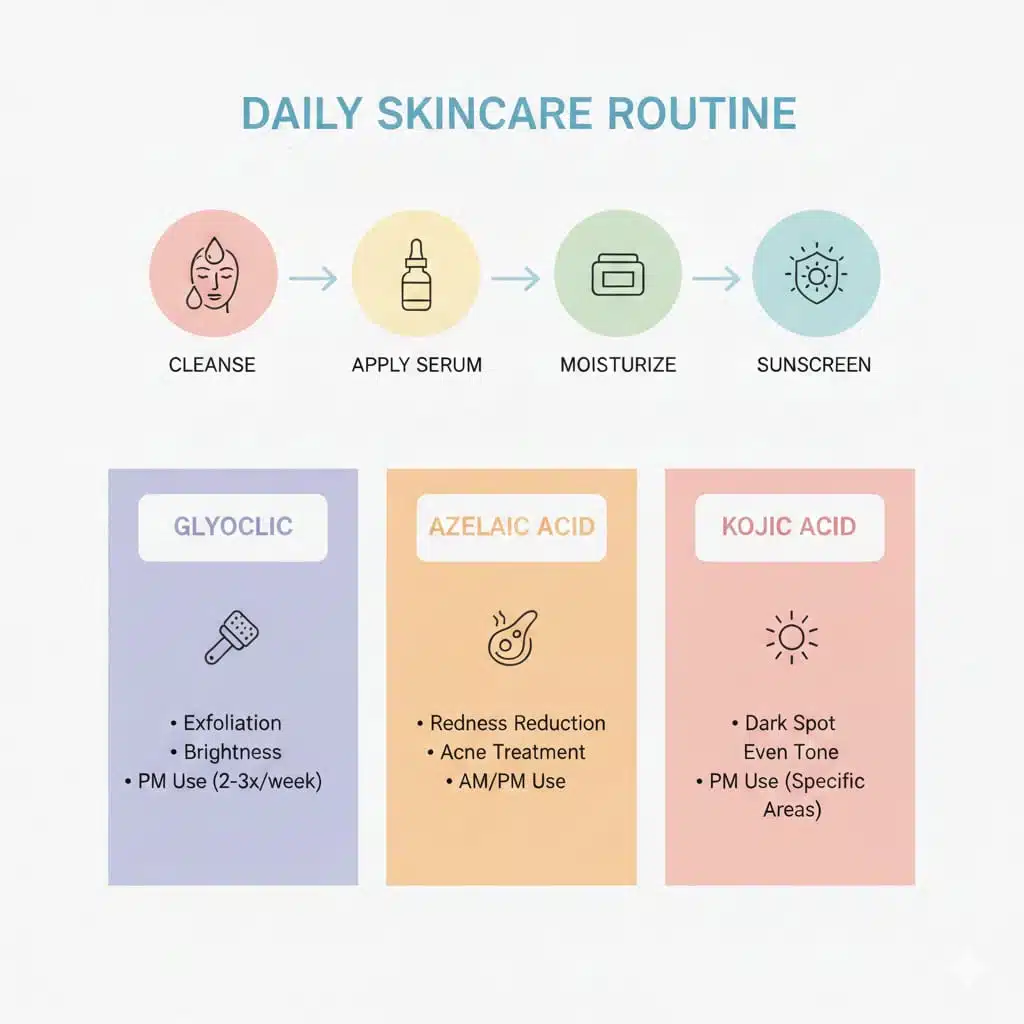 Choosing between glycolic acid vs azelaic acid vs kojic acid doesn’t have to be complicated. This framework helps you match the right acid to your exact situation.
Choose Based on Your Primary Skin Concern
For Stubborn Melasma:
If melasma is your main battle, kojic acid typically delivers the strongest melanin-blocking results. Based on clinical studies cited earlier, kojic acid combined with other brightening agents showed superior melasma clearance rates.
Best choice: Kojic acid (2% to 4%)
Second choice: Azelaic acid (15% to 20%)
Consider: Combining kojic acid with glycolic acid for enhanced results
For Post-Acne Dark Spots (Post-Inflammatory Hyperpigmentation):
Azelaic acid wins here because it addresses both the lingering pigmentation and prevents new breakouts. Its antibacterial properties kill acne-causing bacteria while tyrosinase inhibition fades existing marks.
Best choice: Azelaic acid (10% to 20%)
Second choice: Glycolic acid (8% to 10%)
Avoid initially: Kojic acid (focus on acne control first)
For Dull Skin with Rough Texture Plus Dark Spots:
Glycolic acid is your answer when you need multi-tasking treatment. It exfoliates dead cells causing dullness while gradually fading pigmentation and stimulating collagen for smoother texture.
Best choice: Glycolic acid (7% to 10%)
Second choice: Azelaic acid (for sensitive types)
Advanced option: Alternate glycolic acid with kojic acid
For Rosacea with Hyperpigmentation:
This is non-negotiable. Only azelaic acid is clinically proven safe and effective for rosacea while treating pigmentation. Both glycolic and kojic acid will likely trigger flares.
Only choice: Azelaic acid (15% to 20% prescription)
Avoid completely: Glycolic acid and kojic acid
For General Brightening and Prevention:
If you want overall radiance and even tone without specific problem areas, glycolic acid provides the fastest visible glow through surface exfoliation.
Best choice: Glycolic acid (5% to 7% for maintenance)
Gentle alternative: Azelaic acid (10%)
Not necessary: Kojic acid (too strong for prevention alone)
Choose Based on Your Skin Type
Sensitive or Reactive Skin:
Which acid should i start with for hyperpigmentation if I have sensitive skin? Azelaic acid is the only safe starting point. Clinical evidence confirms its low irritation profile even at prescription strength.
Start with: Azelaic acid (10%, build to 15-20%)
Avoid initially: Glycolic acid and kojic acid
Later option: Low-percentage glycolic acid (5%) after 3 months of tolerance
Oily or Acne-Prone Skin:
You can tolerate stronger exfoliation and benefit from oil control. Either glycolic or azelaic acid works well, depending on whether acne is currently active.
Active acne: Azelaic acid (kills bacteria + fades marks)
No active acne: Glycolic acid (faster exfoliation + texture)
Stubborn spots: Add kojic acid after acne is controlled
Dry or Mature Skin:
Dryness requires careful acid selection. Glycolic acid helps with both pigmentation and fine lines but needs excellent moisturization support.
Best choice: Glycolic acid (7% to 10%) with rich moisturizer
Gentle option: Azelaic acid (less drying)
Use cautiously: Kojic acid (can be very drying)
Combination Skin:
The T-zone tolerates stronger treatment while cheeks need gentler care. Azelaic acid’s balanced profile suits combination skin well.
Most versatile: Azelaic acid (works on all zones)
Zone treatment: Glycolic on oily areas, azelaic on dry areas
Advanced: Alternate between acids based on skin behavior
Dark Skin Tones (Fitzpatrick IV-VI):
Risk of post-inflammatory hyperpigmentation from irritation makes gentleness crucial. Research specifically validates azelaic acid’s safety for darker skin tones.
Safest choice: Azelaic acid (specifically studied for skin of color)
Use with caution: Glycolic acid (low %, monitor closely)
Higher risk: Kojic acid (irritation can worsen pigmentation in dark skin)
Choose Based on Special Circumstances
Pregnant or Breastfeeding:
What acid is best for my skin type during pregnancy? Only azelaic acid has FDA Category B safety designation with proven pregnancy safety data.
Safe to use: Azelaic acid only (FDA Category B)
Use with caution: Low-percentage glycolic acid (under 10%, consult OB-GYN)
Avoid completely: Kojic acid (insufficient safety data)
Budget Constraints:
In Pakistan, pricing varies significantly. Glycolic acid offers the most affordable entry point with effective results.
Most affordable: Glycolic acid (Rs. 500 to Rs. 1,200 for quality options)
Mid-range: Kojic acid soap (Rs. 650 to Rs. 1,500)
Higher investment: Azelaic acid (Rs. 1,500 to Rs. 2,500 for prescription)
First-Time Acid Users:
Which acid should i start with for hyperpigmentation as a complete beginner? Start with the gentlest effective option to build tolerance.
Beginner-friendly: Azelaic acid (10%) or low glycolic acid (5-7%)
Build up to: Higher percentages after 6 to 8 weeks
Advanced only: Kojic acid (after experience with gentler acids)
Maximum Results, Willing to Accept Irritation:
If you’ve tried everything and need the strongest melanin-blocking available over-the-counter, kojic acid offers the most aggressive approach.
Strongest option: Kojic acid (2% to 4%)
Enhanced protocol: Combine with glycolic acid (alternate nights)
Medical supervision: Consider prescription hydroquinone if acids fail
Quick Decision Tree
Start here: Do you have active acne?
→ Yes: Azelaic acid
→ No: Continue to next question
Are you pregnant or breastfeeding?
→ Yes: Azelaic acid only
→ No: Continue to next question
Is your skin very sensitive or do you have rosacea?
→ Yes: Azelaic acid only
→ No: Continue to next question
Do you have stubborn melasma?
→ Yes: Kojic acid (or azelaic acid if sensitive)
→ No: Continue to next question
Do you want texture improvement plus brightening?
→ Yes: Glycolic acid
→ No: Azelaic acid (most versatile for pure pigmentation)
This framework eliminates guesswork when deciding between glycolic acid vs azelaic acid vs kojic acid. Your specific circumstances point clearly to the best starting choice.
How to Combine Multiple Acids Safely
Can i use all three acids together? This is one of the most common questions about glycolic acid vs azelaic acid vs kojic acid. The answer is yes, but with careful planning to avoid overwhelming your skin.
The Golden Rules of Combining Acids
A general rule of thumb is to layer 2 to 3 serums maximum. This ensures skin doesn’t become overwhelmed and gives each formula the space to absorb properly DrugBank.
Apply acids from thinnest to thickest consistency (toners, then serums, then creams). Layer similar acids together but with caution. For example, glycolic and lactic acid may be used in alternating routines, not stacked in one session Typology.
Core principles:
- Never use more than two exfoliating acids in the same routine
- Space high-strength acids at different times of day or different days
- Always include hydrating ingredients (hyaluronic acid, niacinamide)
- Less is more (2 to 4 acid treatments per week, not daily)
- Introduce one acid at a time, waiting 4 weeks before adding another
How to Layer Glycolic Acid and Azelaic Acid
This combination works well because they tackle hyperpigmentation through different mechanisms without redundancy.
If you’re using two separate products, the primary thing to consider is texture. Apply the thinnest product first, then layer thicker formulations second Wikipedia.
Method 1: Same Routine (Advanced Users)
Apply glycolic acid first to exfoliate and prep the skin. Wait 20 minutes for complete absorption and pH optimization. Then apply azelaic acid to reduce inflammation and target melanin production.
Morning routine:
- Cleanser
- Azelaic acid 10% serum
- Niacinamide (optional)
- Moisturizer
- SPF 50+
Evening routine:
- Cleanser
- Glycolic acid 7% to 10% toner
- Wait 20 minutes
- Moisturizer
Method 2: Alternating Days (Beginners)
This reduces irritation risk while still providing comprehensive treatment.
- Monday, Wednesday, Friday: Glycolic acid PM
- Tuesday, Thursday, Saturday: Azelaic acid PM
- Sunday: Recovery (hydration only, no actives)
How to Layer Glycolic Acid and Kojic Acid
This powerful brightening combination requires more caution due to combined irritation potential.
Method 1: Different Times of Day
- Morning: Kojic acid 2% serum, followed by vitamin C, moisturizer, SPF 50+
- Evening: Glycolic acid 7% to 10%, wait 15 minutes, moisturizer
This separation prevents overloading skin with two potent treatments simultaneously.
Method 2: Alternating Nights (Safest)
- Monday, Wednesday, Friday: Glycolic acid PM
- Tuesday, Thursday, Saturday: Kojic acid PM
- Daily AM: Vitamin C and SPF 50+
You can apply acids at different times of the day. However, if you want to use them together, apply the thinnest layer first, but this can increase the risk of irritation ScienceDirect.
How to Layer Azelaic Acid and Kojic Acid
These two melanin inhibitors complement each other well since they block tyrosinase through slightly different pathways.
Recommended approach:
- Morning: Kojic acid 2% serum
- Evening: Azelaic acid 10% to 20%
- Both applications: Follow with niacinamide for enhanced brightening
In the morning, alternate between products. In the evening, use azelaic acid suspension for consistent melanin blocking without over-treatment Cosmetics Info.
This combination suits stubborn melasma particularly well. The kojic acid provides aggressive tyrosinase inhibition during daytime while azelaic acid offers anti-inflammatory benefits at night.
Can You Use All Three Acids Together?
Yes, but only for advanced users with resilient skin treating very stubborn hyperpigmentation.
The rotation method (safest for using all three):
Week 1-2 Schedule:
- Monday AM: Kojic acid, SPF 50+ | PM: Azelaic acid
- Tuesday AM: Vitamin C, SPF 50+ | PM: Recovery (hydration only)
- Wednesday AM: Kojic acid, SPF 50+ | PM: Glycolic acid
- Thursday AM: Vitamin C, SPF 50+ | PM: Azelaic acid
- Friday AM: Kojic acid, SPF 50+ | PM: Recovery
- Weekend: Hydration focus, no actives
After 2 weeks, assess skin tolerance. If no irritation, increase frequency gradually.
Warning signs to stop immediately:
- Burning sensation lasting more than 5 minutes
- Persistent redness for hours after application
- Excessive peeling or flaking
- Skin feels tight, raw, or uncomfortable
- New breakouts appearing
Supporting Ingredients to Include
When combining multiple acids, these ingredients help prevent irritation:
Niacinamide: Reduces inflammation, strengthens skin barrier, enhances brightening. Apply after acids have absorbed fully.
Hyaluronic acid: Provides intense hydration to counteract potential dryness. Layer after all acids.
Ceramides: Repair and protect skin barrier. Use in your moisturizer both AM and PM.
Centella asiatica: Soothes irritation and reduces redness. Look for products with this ingredient.
Hyaluronic acid doesn’t function like an AHA or BHA in that it does not strip your skin. It’s actually highly nourishing and hydrating, making it ideal for applying after any exfoliating acids Medical News Today.
What Not to Combine
Combining AHAs and BHAs with retinol can cause serious irritation if the products are used together. We recommend alternating using these products on different nights of your skincare routine Medical News Today.
Never combine in the same routine:
- Glycolic acid + retinol (use glycolic AM, retinol PM OR alternate nights)
- Kojic acid + retinol (too irritating together)
- Multiple exfoliating acids + vitamin C (pick one acid, save vitamin C for morning)
- Three acids + retinol (choose maximum two actives per routine)
Sample Weekly Schedule for Multiple Acids
For combination glycolic + azelaic + kojic (advanced routine):
| Day | Morning | Evening |
| Monday | Kojic acid 2%, SPF 50+ | Azelaic acid 15% |
| Tuesday | Vitamin C, SPF 50+ | Glycolic acid 10% |
| Wednesday | Kojic acid 2%, SPF 50+ | Azelaic acid 15% |
| Thursday | Vitamin C, SPF 50+ | Recovery (hydration) |
| Friday | Kojic acid 2%, SPF 50+ | Glycolic acid 10% |
| Saturday | Vitamin C, SPF 50+ | Azelaic acid 15% |
| Sunday | Hydration focus | Recovery (no actives) |
This schedule ensures you never use more than two acids in 24 hours and includes recovery days to prevent over-exfoliation.
Product Recommendations for Pakistan
Finding authentic, effective acid products in Pakistan can be challenging. Here are the best options available locally with verified pricing and where to buy them.
Best Glycolic Acid Products in Pakistan
Bio One Glycolic Acid Cream (5%, 10%, 12%)
Bio One offers pharmaceutical-grade glycolic acid creams in multiple strengths (5%, 10%, 12%) with precise concentrations and pH for reliable results ScienceDirect. The 12% concentration is strong and may cause burning for 5 to 10 minutes initially.
Price: Rs. 800 to Rs. 1,500
Where to buy: Derma.pk, local pharmacies
Best for: Experienced users wanting medical-grade results
Trego Glycolic Acid Toner (5%)
This toner contains 5% glycolic acid with tartaric acid, making it suitable for all skin types in Pakistan, and treats strawberry legs, underarms smell, and dark patches on the body DrugBank.
Price: Rs. 650 to Rs. 900
Where to buy: Trego.pk, delivers across Pakistan
Best for: Beginners, body hyperpigmentation
ChiltanPure Glycolic Serum
ChiltanPure Glycolic serum is formulated by a team of pharmacists and chemists, known for effective skin-renewing properties and stimulating collagen production Specialchem.
Price: Rs. 1,299
Where to buy: ChiltanPure.com (delivers to Karachi, Lahore, Islamabad, Faisalabad nationwide)
Best for: Pakistani skin types, trusted local brand
L’Oreal Paris Revitalift 10% Pure Glycolic Acid Serum
This serum contains 10% glycolic acid and is recommended for users who have already built tolerance to glycolic acid MarketsandMarkets.
Price: Rs. 2,000 to Rs. 2,500
Where to buy: Major retailers, beauty stores
Best for: Advanced users wanting international brand quality
For complete glycolic acid usage instructions and additional products, see my glycolic acid for hyperpigmentation guide.
Best Azelaic Acid Products in Pakistan
The Ordinary Azelaic Acid Suspension 10%
The Ordinary Azelaic Acid 10% is a popular and affordable option with a lightweight cream-gel formula that absorbs quickly without greasy residue, with lower chance of causing irritation PubMed CentralDANG! Lifestyle.
Price: Rs. 1,800 to Rs. 2,200
Where to buy: Derma.pk
Best for: Sensitive skin, beginners, international brand trust
ChiltanPure Azelaic Serum
This serum contains azelaic acid that reduces blemishes, fades acne marks, promotes collagen production, and has antibacterial properties to prevent white and blackheads Caudalie.
Price: Rs. 1,299
Where to buy: ChiltanPure.com (nationwide delivery)
Best for: Budget-friendly local option, acne and pigmentation
ChiltanPure Azelaic Cream
Water-based cream used to treat freckles, acne, improve skin texture and tone, making it bright, clear, and less bumpy Dermatologistschoice.
Price: Rs. 1,099
Where to buy: ChiltanPure.com
Best for: Dry skin types needing moisturizing formula
Acnorine 15% Azelaic Acid Cream (Prescription)
Medical-grade 15% azelaic acid cream by Tarrot Health Care for treating acnes and acne scars PubMed Central.
Price: Rs. 800 to Rs. 1,200
Where to buy: Medishop.pk, local pharmacies
Best for: Prescription-strength treatment under dermatologist supervision
Best Kojic Acid Products in Pakistan
Kojie San Skin Lightening Soap (2%)
The original kojic acid soap formulated with authentic kojic acid, coconut oil, and tea tree oil to reduce age spots, hyperpigmentation, melasma, freckles, and scars PubMed.
Price: Rs. 650 to Rs. 799
Where to buy: Daraz.pk, Korean Home, local beauty stores
Best for: Body hyperpigmentation, dark underarms, budget-friendly
ChiltanPure Kojic Serum (100% Pure Organic)
Pure kojic acid serum that works by blocking tyrosine formation, preventing melanin production for skin lightening effects Dot & Key.
Price: Rs. 1,299
Where to buy: ChiltanPure.com (delivers to Karachi, Lahore, Rawalpindi, Islamabad, Faisalabad nationwide)
Best for: Facial melasma, targeted dark spot treatment
ChiltanPure Kojic Cream
Skin-whitening moisturizer that prevents tyrosine synthesis necessary for melanin growth, with anti-inflammatory, antioxidant, and brightening properties PubMed.
Price: Rs. 1,099
Where to buy: ChiltanPure.com
Best for: Dry skin, full-face application
Kilarca Kojic Acid Skin Lightening Soap
Premium soap formulated with Korean-based natural ingredients and Zero Pigment Light Technology, promising visible results within 7 days Typology.
Price: Rs. 2,099 to Rs. 3,599
Where to buy: Kilarca.com (2-4 days delivery across Pakistan)
Best for: Premium formulation, faster-acting option
For complete kojic acid safety information, percentages, and melasma treatment protocols, see my kojic acid for melasma guide.
Where to Shop Online in Pakistan
Derma.pk: Most comprehensive selection, pharmaceutical-grade products, fast delivery, orders over Rs. 5,000 ship free
ChiltanPure.com: Trusted Pakistani brand, natural formulations, nationwide delivery (Karachi, Lahore, Islamabad, Rawalpindi, Faisalabad)
Daraz.pk: Wide variety, competitive pricing, buyer protection, cash on delivery available.
Conclusion: Making Your Final Choice
Choosing between glycolic acid vs azelaic acid vs kojic acid depends on your specific needs. Pick azelaic acid for sensitive skin, pregnancy, or acne plus pigmentation. Choose glycolic acid for fastest results (6-8 weeks) and texture improvement. Select kojic acid for stubborn melasma resistant to other treatments.
Most people succeed with one acid used consistently with SPF 50+ daily. For complete usage guides, read my glycolic acid, azelaic acid, and kojic acid detailed posts. Start today for clearer, even-toned skin
Frequently Asked Questions
Most people achieve excellent results with just one acid chosen for their specific concern. Combining acids delivers enhanced results for stubborn hyperpigmentation but requires more careful application and monitoring.
Which is better for melasma: glycolic or kojic acid?
Kojic acid is more effective for melasma because it directly blocks tyrosinase enzyme activity at the source of melanin production. Glycolic acid helps through surface exfoliation but doesn’t stop melanin synthesis. For stubborn melasma, kojic acid (2-4%) or combining both acids (glycolic AM, kojic PM) delivers best results.
Which acid is safest for dark skin?
Azelaic acid remains the safest and most effective treatment for hyperpigmentation in darker skin tones, according to clinical studies Typology. Glycolic and kojic acid carry higher risk of post-inflammatory hyperpigmentation if they cause irritation in dark skin.
Can I use retinol with any of these Glycolic, azelaic and kojic acid?
Not in the same routine. All three acids can be combined with retinol but require separation. Use your chosen acid (glycolic, azelaic, or kojic) in the morning and retinol at night. Or alternate nights entirely. Never layer retinol with exfoliating acids in one routine as it causes severe irritation and barrier damage.
How long until I see results from Glycolic, azelaic and kojic acid?
Glycolic acid shows first improvements at 6 to 8 weeks. Azelaic acid requires 8 to 12 weeks for visible dark spot fading. Kojic acid takes 8 to 12 weeks for general hyperpigmentation, 12 to 16 weeks for melasma. Consistency matters more than speed. Missing applications significantly delays all results.
Which acid is best value for money in Pakistan?
Glycolic acid offers best value with effective products from Rs. 650 to Rs. 1,500 (Trego toner, ChiltanPure serum). Kojic acid soap (Kojie San at Rs. 650-799) provides affordable body treatment. Azelaic acid costs more (Rs. 1,200 to Rs. 2,500) but prescription strength delivers stronger results. Budget doesn’t determine effectiveness.
Can I use Glycolic, azelaic and kojic acid in summer in Pakistan?
Yes, but with strict precautions. All three acids increase sun sensitivity, critical concern in Pakistan’s intense summer sun. Apply acids at night only during summer months. Use SPF 50+ every 2 hours when outdoors. Consider pausing treatment during extended beach vacations. Azelaic acid has lowest sun sensitivity risk.
Which acid works for both acne and dark spots?
Azelaic acid is specifically designed to treat both active acne and dark spots simultaneously. Its antibacterial properties kill acne-causing bacteria while tyrosinase inhibition fades marks. Glycolic acid helps prevent acne through exfoliation but isn’t as effective for active breakouts. Kojic acid focuses purely on pigmentation, not acne.
Are Glycolic, azelaic and kojic acid safe for daily use?
Azelaic acid can be used once or twice daily once tolerated. Glycolic acid (5-7%) can build to daily use but start every other day. Kojic acid (1-2%) may be used daily after tolerance builds, higher percentages need alternate days. Always listen to your skin. Irritation, dryness, or burning means reduce frequency immediately.
What should I not mix with acids?
Never combine with benzoyl peroxide (neutralizes acids), physical scrubs (over-exfoliation), multiple strong acids simultaneously, or vitamin C in same routine as glycolic acid. Safe combinations: hyaluronic acid, niacinamide, ceramides, peptides. Use retinol separately (different time or different day).
Do Glycolic, azelaic and kojic acid cause purging?
Glycolic acid may cause mild purging (increased breakouts) in first 2 to 4 weeks as it accelerates cell turnover. Azelaic acid rarely causes purging but may trigger initial mild breakouts. Kojic acid doesn’t typically cause purging.
Which acid is best for Pakistani skin tones?
Azelaic acid is specifically recommended for South Asian and darker skin tones due to its low irritation risk and proven safety in melanin-rich skin. Start with azelaic acid if you’re Fitzpatrick skin type IV-VI. Glycolic acid works but requires lower percentages (5-7%) and careful monitoring. Kojic acid needs extra caution in dark skin.
Glycolic acid or azelaic acid for acne scars?
Azelaic acid is better for pigmented acne marks (dark spots left after acne heals) because it blocks melanin production. Glycolic acid works better for depressed/textured acne scars as it stimulates collagen through exfoliation. If you have both dark marks and texture, use azelaic acid first to fade pigmentation, then add glycolic acid for texture improvement.
Is kojic acid stronger than glycolic acid?
For melanin-blocking, yes. Kojic acid inhibits tyrosinase more aggressively, making it stronger for stubborn melasma. However, glycolic acid delivers faster visible results (6-8 weeks vs 8-12 weeks) through exfoliation. Kojic acid also causes more irritation. Stronger for pigment blocking: kojic acid. Faster overall results: glycolic acid.