
Glycolic Acid for Hyperpigmentation: Ultimate Guide (2026)
I still remember the day I looked in the mirror and realized my dark spots weren’t fading, no matter how many brightening serums I slathered on. That’s when I discovered glycolic acid, and honestly, it changed everything about my approach to hyperpigmentation.
If you’ve landed here, you’re probably wondering: what does glycolic acid do to skin, and more importantly, is glycolic acid good for hyperpigmentation? The answer is a resounding yes but only if you use it correctly.
In this comprehensive guide, I’ll walk you through everything you need to know about using glycolic acid for hyperpigmentation.
I’ve also written extensively about other powerful acids for hyperpigmentation, including azelaic acid, and I’ll be covering kojic acid soon.
What Is Glycolic Acid? Understanding the Basics
Before we dive into how glycolic acid transforms your skin, let’s start with the fundamentals because understanding what you’re putting on your face is half the battle.
Is Glycolic Acid an AHA?
Yes, glycolic acid is an alpha-hydroxy acid (AHA), which is a group of naturally occurring acids derived from various sources. What makes glycolic acid special is that it’s extracted from sugar cane, giving it unique properties that set it apart from other AHAs like lactic acid (from milk) or mandelic acid (from almonds).
AHAs are water-soluble acids that work primarily on the surface of your skin. Unlike beta-hydroxy acids (BHAs) like salicylic acid, which penetrate into your pores, glycolic acid focuses on exfoliating the outermost layers of skin. This makes it particularly effective for surface-level concerns like hyperpigmentation, dullness, and fine lines.
What Does Glycolic Acid Do to Skin?
Glycolic acid works as a chemical exfoliant by breaking down the bonds that hold dead skin cells together on the surface of your skin.
Accelerates cell turnover: Your skin naturally sheds dead cells every 28 to 40 days (longer as you age). Glycolic acid speeds up this process, bringing newer, brighter cells to the surface faster.
Stimulates collagen production:
By creating controlled micro-damage to the skin’s surface, glycolic acid triggers your skin’s healing response, which includes producing more collagen and elastin. These are the proteins responsible for firm, youthful skin.
Improves skin texture:
Regular use smooths rough patches, minimizes the appearance of pores, and creates a more even surface texture.
Enhances product absorption:
By removing the barrier of dead skin cells, glycolic acid allows your other skincare products (serums, moisturizers, treatments) to penetrate more effectively.
Fades hyperpigmentation:
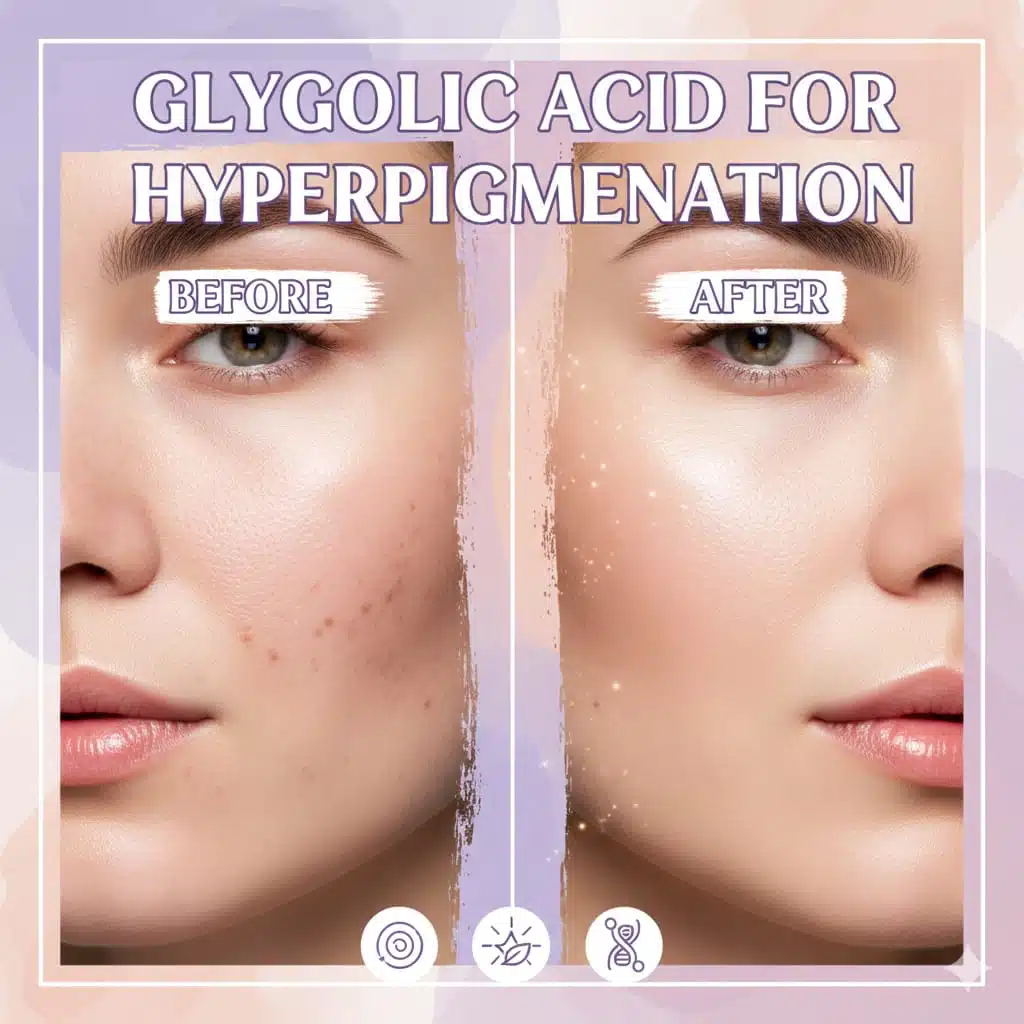
This is the big one. Glycolic acid breaks up clusters of melanin (the pigment that causes dark spots) and brings them to the surface where they can be shed. Over time, this results in a more even skin tone.
The key difference between glycolic acid and physical exfoliants (like scrubs) is that glycolic acid works at a cellular level without the mechanical friction that can cause micro-tears in your skin.
Is Glycolic Acid Good for Hyperpigmentation?
Absolutely. Glycolic acid targets hyperpigmentation through multiple mechanisms. First, it removes the surface layer of dead, discolored skin cells that make dark spots visible. Second, it inhibits the production of excess melanin by interfering with the enzymes responsible for pigmentation. Third, it speeds up cell turnover so that pigmented cells are replaced faster with fresh, evenly toned skin.
Glycolic Acid Benefits
Beyond hyperpigmentation, glycolic acid offers an impressive range of skin benefits:
Exfoliates dead skin cells: By dissolving the bonds between dead cells, it reveals the brighter, healthier skin beneath and prevents the dullness that comes from cellular buildup.
Reduces acne and prevents breakouts: Glycolic acid keeps pores clear by removing dead skin cells and excess oil that can clog them. It also has mild antibacterial properties that help control acne-causing bacteria.
Fades acne scars and post-inflammatory marks: Because it accelerates skin renewal, glycolic acid helps fade the red, brown, or purple marks that linger after a breakout heals. It works particularly well on shallow, surface-level scarring.
Minimizes fine lines and wrinkles: By stimulating collagen production in the deeper layers of skin, glycolic acid helps plump fine lines and improve skin elasticity over time. This makes it a valuable anti-aging ingredient, especially for early signs of aging.
Evens out skin texture: If your skin feels rough, bumpy, or uneven to the touch, glycolic acid smooths the surface by removing built-up dead cells and promoting healthy cell turnover. This creates a softer, more refined texture.
Shrinks the appearance of pores: While glycolic acid can’t physically change pore size (that’s determined by genetics), it can make pores appear smaller by keeping them clear of debris and oil buildup.
Boosts radiance and glow: One of the most immediate benefits people notice is that “lit from within” glow. By removing the dull outer layer of skin, glycolic acid reveals the luminous, healthy skin underneath.
Enhances absorption of other products: When the surface layer of dead cells is removed, your serums, moisturizers, and treatments can penetrate more effectively. This means your entire skincare routine becomes more efficient.
Improves skin hydration: This might seem counterintuitive for an exfoliant, but by removing the barrier of dead cells, glycolic acid actually allows moisture to penetrate better. It also stimulates the production of hyaluronic acid in the skin, which helps retain water.
Is Glycolic Acid Good For Dark Spots and Hyperpigmentation
Glycolic acid tackles hyperpigmentation through a three-pronged approach at the cellular level.
Exfoliates pigmented cells: Dark spots exist in the upper layers of your skin where excess melanin has accumulated. Glycolic acid dissolves the bonds holding these pigmented dead cells on the surface, allowing them to shed naturally.
Inhibits melanin production: Glycolic acid interferes with tyrosinase, the enzyme responsible for melanin synthesis. By reducing the activity of this enzyme, it helps prevent new dark spots from forming while you’re working to fade existing ones.
Disperses melanin clusters: Melanin doesn’t always distribute evenly. Sometimes it clumps together in concentrated areas, creating darker patches. Glycolic acid helps break up these clusters and disperse the pigment more evenly throughout the skin layers.
What the Research Shows
Clinical studies have demonstrated glycolic acid’s effectiveness for hyperpigmentation. A 12-week clinical study published in the Journal of Cosmetic Dermatology found that participants using 10% glycolic acid daily experienced significant improvement in post-inflammatory hyperpigmentation and overall skin luminosity.
Timeline for Results
Weeks 1 to 2: Your skin may look brighter overall, but dark spots won’t appear significantly lighter yet. Some people experience mild purging as the acid brings deeper pigmentation to the surface.
Weeks 3 to 4: You’ll start noticing that dark spots look slightly less intense. The edges may appear softer and less defined.
Weeks 6 to 8: This is when most people see noticeable improvement. Dark spots continue to fade, and overall skin tone becomes more even.
Weeks 12+: Maximum results become visible. Stubborn spots continue to lighten, though very deep pigmentation may require continued use for 6 months or longer.
The key to success is consistency and pairing glycolic acid with strict sun protection. Always use SPF 30 or higher during the day, even when it’s cloudy.
Glycolic Acid Percentage Guide: What Strength Do You Need?
Choosing the right glycolic acid percentage is crucial for getting results without irritation.
Understanding Glycolic Acid Concentrations
Glycolic acid products range from 5% to 70%, but not all percentages are suitable for home use.
Glycolic Acid Percentage Breakdown
Here’s how to choose the right strength based on your experience level and skin type:
| Percentage | Skin Type | Best For | Frequency |
| 5% to 7% | Beginners, Sensitive skin | Daily gentle exfoliation, First-time users | Every day or every other day |
| 8% to 10% | Normal to combination skin | Regular maintenance, Visible results | 3 to 4 times per week |
| 10% to 15% | Experienced users, Oily skin | Active treatment, Stubborn hyperpigmentation | 2 to 3 times per week |
| 15% to 20% | Very oily, Resilient skin | Intensive treatment, Deep exfoliation | 1 to 2 times per week |
| 20% to 30% | Professional use only | At-home peels (if experienced) | Once every 2 to 4 weeks |
| 30% to 70% | Professional use only | In-office chemical peels | Monthly treatments by professionals |
Starting with Lower Percentages
If you’re new to glycolic acid, start with 5% to 7%. The Ordinary Glycolic Acid 7% Toning Solution is an excellent starting point because it’s gentle enough for daily use while still being effective. This allows your skin to build tolerance without overwhelming it.
For Sensitive Skin
If you have sensitive skin, rosacea, or eczema, stick with 5% or lower. You might also want to look at other AHAs like lactic acid or mandelic acid, which have larger molecular sizes and penetrate less deeply, making them gentler options. That said, many people with sensitive skin successfully use low-percentage glycolic acid by applying it every other day or just twice a week.
For Hyperpigmentation Treatment
For treating dark spots and hyperpigmentation specifically, concentrations between 8% and 15% tend to work best for at-home use. Using 10% glycolic acid three times per week for three months will give you better results than using 20%.
How to Use Glycolic Acid: Step-by-Step Guide
Using glycolic acid correctly is just as important as choosing the right percentage.
For First-Time Users: The Beginner Protocol
Step 1: Patch Test (Days 1-2) Apply a small amount of glycolic acid to your inner forearm or behind your ear. Wait 24 to 48 hours. If you experience severe burning, swelling, or rash, your skin may be too sensitive for glycolic acid. Mild tingling is normal.
Step 2: Start With Low Frequency (Week 1-2) Use glycolic acid just twice per week, on non-consecutive nights (like Monday and Thursday). This gives your skin time to adjust without overwhelming it.
Step 3: Gradually Increase (Week 3-6) If your skin tolerates it well with no excessive redness or peeling, increase to three times per week. After another 2 to 3 weeks, you can move to every other night if desired.
Step 4: Monitor Your Skin Watch for signs of over-exfoliation: persistent redness, flaking, burning sensation, increased sensitivity, or new breakouts. If these occur, reduce frequency immediately.
Daily Application: The Right Way
Cleanse first: Apply glycolic acid to completely clean, dry skin. Any residue from makeup, sunscreen, or oil can create a barrier that prevents the acid from working properly. Wait 2 to 3 minutes after cleansing to ensure your skin is fully dry.
Apply a thin layer: You only need a small amount. Whether using a toner, serum, or pad, apply an even layer across your entire face, avoiding the immediate eye area and lips.
Wait before layering: This is crucial. Let the glycolic acid sit on your skin for 10 to 20 minutes before applying anything else. This wait time allows the acid to work at the proper pH level.
Follow with moisturizer: After waiting, apply a hydrating, gentle moisturizer. Glycolic acid can be temporarily dehydrating, so replenishing moisture is essential. Look for moisturizers with ceramides, hyaluronic acid, or niacinamide.
Always use SPF in the morning: This is non-negotiable. Glycolic acid increases sun sensitivity for up to a week after use. Apply SPF 30 or higher every single morning, even on cloudy days or when staying indoors.
Glycolic Acid Morning or Night?
Use glycolic acid at night, not in the morning. Here’s why:
Night time application gives the acid hours to work without interference from sunlight, makeup, or other environmental factors. Your skin does most of its repair and regeneration while you sleep, making night time the optimal window for active treatments.
Sample Night time Routine
Step 1: Cleanser (oil-based if wearing makeup, then water-based)
Step 2: Pat skin completely dry, wait 2-3 minutes
Step 3: Apply glycolic acid toner or serum
Step 4: Wait 10-20 minutes (scroll your phone, read, whatever)
Step 5: Apply hydrating serum (optional, like hyaluronic acid)
Step 6: Moisturizer
Step 7: Eye cream (if using)
Sample Morning Routine (Non-Glycolic Days)
Step 1: Gentle cleanser
Step 2: Antioxidant serum (vitamin C works great here)
Step 3: Moisturizer
Step 4: SPF 30+ sunscreen
Best Glycolic Acid Products: 2026 Recommendations
Choosing the right glycolic acid product can be overwhelming with hundreds of options available. Here are the best performers across different categories based on formulation, percentage, price, and user results.
Best Overall: The Ordinary Glycolic Acid 7% Toning Solution
This is the product I recommend most often for beginners and experienced users alike. At 7% glycolic acid with a pH of 3.5 to 3.7, it strikes the perfect balance between effectiveness and gentleness.
The texture is liquid, not sticky, and absorbs quickly. You can use it daily once your skin adjusts, though most people find three to four times per week ideal. At around $8 to $13 for 240ml, it’s exceptional value. One bottle lasts 3 to 4 months with regular use.
Best for: First-time glycolic acid users, sensitive skin building tolerance, budget-conscious shoppers, daily gentle exfoliation
Where to buy: Sephora, Ulta, The Ordinary website, Beautylish
Best Toner: Mario Badescu Glycolic Acid Toner
Mario Badescu has been a skincare staple for decades. Formulated with glycolic acid alongside grapefruit extract and aloe vera, this toner refreshes while treating hyperpigmentation and texture issues.
The grapefruit extract provides additional brightening through vitamin C, while aloe soothes any potential irritation. It has a subtle citrus scent that some people love and others find too strong.
Best for: Combination to oily skin, morning routines (with SPF), people who prefer traditional toner textures, those wanting a gentler glycolic option
Price: Around $18 to $22 for 236ml
Where to buy: Ulta, Amazon, Mario Badescu website
Best Serum: Vichy Normaderm Phytosolution Double-Correction Daily Care
If you prefer serum consistency over toner, Vichy’s formula combines 10% glycolic acid with salicylic acid and hyaluronic acid. This combination targets both hyperpigmentation and active acne while maintaining hydration.
The texture is gel-like and absorbs without leaving residue.
Best for: Oily, acne-prone skin, post-inflammatory hyperpigmentation, combination concerns (acne plus dark spots)
Price: Around $30 to $35 for 50ml
Note: Not ideal for sensitive skin due to the dual-acid formula.
Best Budget Option: Reviva Labs Glycolic Acid Facial Cleanser
At under $10, this glycolic acid cleanser provides gentle exfoliation without the commitment of leave-on products. It contains 5% glycolic acid, making it suitable for beginners or those who find leave-on acids too intense.
Best for: Glycolic acid beginners, very sensitive skin, budget shoppers, people intimidated by leave-on acids
Price: Around $8 to $12 for 4 oz
Limitation: Less effective than leave-on products for stubborn hyperpigmentation, but good for maintenance and introduction.
Best for Sensitive Skin: Paula’s Choice 8% AHA Gel Exfoliant
While this contains glycolic acid as one of several AHAs (also includes lactic acid), the 8% total AHA concentration is formulated specifically for sensitive skin. The gel texture is soothing, and the addition of green tea and chamomile reduces inflammation.
Best for: Rosacea-prone skin, sensitive skin types, those who’ve had bad reactions to pure glycolic acid
Price: Around $36 for 100ml
Can You Mix Glycolic Acid With Other Ingredients?
One of the most common questions I get is about combining glycolic acid with other skincare actives. Some combinations amplify results, while others can seriously damage your skin barrier. Here’s what you need to know.
Can You Use Glycolic Acid With Retinol?
This is the most asked question, and the answer is: yes, but with important precautions.
Both glycolic acid and retinol are powerful exfoliants that increase cell turnover. Using them together in the same routine creates a high risk of over-exfoliation, leading to redness, peeling, sensitivity, and a compromised skin barrier.
The safest approach is alternating nights:
Monday, Wednesday, Friday: Glycolic acid in your PM routine
Tuesday, Thursday, Saturday: Retinol in your PM routine
Sunday: Recovery night with just hydration (no actives)
This schedule gives your skin time to recover between treatments while still getting benefits from both ingredients.
Who should never combine them: People with sensitive skin, rosacea, eczema, or anyone new to either ingredient. Master one active first before introducing the second.
Can You Use Glycolic Acid With Salicylic Acid?
Technically yes, but I don’t recommend it for most people.
Both are exfoliating acids. Using them together dramatically increases the risk of irritation, dryness, and barrier damage. Your skin can only handle so much exfoliation before it rebels.
If you want to use both:
- Use salicylic acid in the morning (it’s less photosensitizing than glycolic)
- Use glycolic acid at night
- Start with just 2 to 3 times per week for each
- Monitor closely for over-exfoliation signs
Better option: Look for products specifically formulated with both acids in balanced concentrations. These are designed to work together without overwhelming skin. Products like Paula’s Choice Skin Perfecting 2% BHA Liquid Exfoliant and The Ordinary’s AHA 30% + BHA 2% Peeling Solution are professionally balanced.
Glycolic Acid and Niacinamide
This is generally a safe combination, though there’s some controversy.
Older studies suggested that niacinamide and acids shouldn’t mix because the acidic pH could convert niacinamide to niacin, causing flushing and irritation.
The Ordinary niacinamide (10% + Zinc 1%) can be used in the same routine as glycolic acid with these guidelines:
Option 1: Apply glycolic acid, wait 10 to 15 minutes, then apply niacinamide serum. The wait time allows the glycolic acid to work at its optimal pH before buffering it with niacinamide.
Option 2: Use glycolic acid at night and niacinamide in the morning. This completely eliminates any interaction risk.
Niacinamide is excellent for hyperpigmentation, oil control, and barrier support. Combined with glycolic acid, it creates a powerful brightening routine.
Safe Combinations: What Works Well
Hyaluronic acid: Perfect pairing. Use hyaluronic acid after glycolic acid to replenish moisture and soothe any potential irritation. Glycolic acid can temporarily dehydrate skin, and hyaluronic acid holds up to 1,000 times its weight in water.
Peptides: Safe to combine. Apply glycolic acid first, wait, then apply peptide serums. Glycolic acid actually enhances peptide absorption by removing the dead cell barrier.
Ceramides: Excellent combination. Ceramides repair and strengthen the skin barrier, which can be stressed by glycolic acid’s exfoliating action. Look for moisturizers rich in ceramides to use after glycolic acid application.
Antioxidants (Vitamin E, Ferulic Acid, Green Tea): These can be layered with glycolic acid. Apply antioxidants in the morning for daytime protection and glycolic acid at night.
Azelaic acid: This combination can work, particularly for stubborn hyperpigmentation. I’ve written a complete guide on azelaic acid and its benefits. Using both creates a comprehensive approach to dark spots. Alternate nights or use azelaic acid in the morning and glycolic at night.
Dangerous Combinations: What to Avoid
Benzoyl peroxide: Never use these together in the same routine. They can neutralize each other and cause severe irritation. If treating acne, use benzoyl peroxide in the morning and glycolic acid at night, or alternate days.
Other AHAs (lactic, mandelic acids): Redundant and unnecessarily harsh. Choose one AHA and stick with it.
Physical exfoliants (scrubs, brushes): Using glycolic acid already provides chemical exfoliation. Adding physical scrubbing is complete overkill and will damage your skin.
Vitamin C (L-Ascorbic Acid): While not dangerous, combining them in the same routine can reduce the effectiveness of both due to pH conflicts. Vitamin C works best at pH 3.0 to 3.5, similar to glycolic acid. They compete rather than complement. Use vitamin C in the morning and glycolic acid at night for best results.
Prescription retinoids (Tretinoin, Adapalene): Even more cautious than over-the-counter retinol. If your dermatologist prescribes tretinoin, ask them directly about introducing glycolic acid. Generally, you’ll need to space them several nights apart.
Glycolic Acid for Specific Skin Concerns
For Ingrown Hairs
Glycolic acid dissolves dead skin cells that trap hair beneath the surface, allowing hair to grow out normally.
How to use:
- Apply 8% to 10% glycolic acid to bikini line, underarms, legs, or beard area
- Use 2 to 3 times per week
- Wait 24 to 48 hours after shaving or waxing before applying
- Apply the night before shaving for best prevention
Results: Significant reduction in bumps and redness within 2 to 3 weeks.
Can I Use Glycolic Acid on Private Area?
Yes, but only externally with caution.
Safety guidelines:
- Use 5% to 7% maximum (lower than face)
- Start once per week, increase to twice weekly if tolerated
- Wait 48 hours after waxing or shaving
- Never apply to internal areas or broken skin
- Stop if burning occurs beyond mild tingling
Glycolic Acid as Deodorant
Glycolic acid lowers skin pH, creating an inhospitable environment for odor-causing bacteria.
Important notes:
- Does NOT stop sweating (not an antiperspirant)
- Only controls odor
How to use:
- Apply 5% to 8% glycolic acid toner to clean underarms at night
- Allow to dry completely
- Results appear within 3 to 7 days
- Wait 24 hours after shaving if irritation occurs
Glycolic Acid for Acne Scars
For dark marks (PIH):
- Use 10% to 15% concentration
- Apply 3 to 4 times per week
- Visible lightening in 6 to 8 weeks
- Stubborn marks: 12 to 16 weeks
For shallow textural scars:
- Stimulates collagen production
- Modest improvement over 3 to 6 months
- Deep ice pick or rolling scars: professional treatment needed
Glycolic Acid for Melasma
Melasma is hormonal hyperpigmentation that’s challenging to treat.
Treatment approach:
- Use 8% to 12% concentration
- Combine with other treatments (azelaic acid, vitamin C)
- Requires 3 to 6 months for improvement
- SPF 50+ mandatory (melasma worsens with any sun exposure)
- Often returns if triggers persist
Glycolic Acid for Body Hyperpigmentation
Target areas: Elbows, knees, underarms, inner thighs
How to use:
- Use body lotions with 10% to 12% glycolic acid
- Apply 3 to 4 times per week after showering
- Body skin tolerates higher percentages than face
- Results: 8 to 12 weeks (slower than face)
Glycolic Acid Safety and Side Effects
Common Side Effects
Normal reactions (expected):
- Mild tingling or stinging upon application (1-2 minutes)
- Slight redness that fades within 30 minutes
- Temporary dryness or flaking (first 1-2 weeks)
- Increased skin sensitivity
When to be concerned:
- Burning that lasts more than 5 minutes
- Persistent redness for hours after application
- Severe peeling or skin that feels raw
- New breakouts that worsen after 4 weeks
- Increased hyperpigmentation (especially on darker skin tones)
Can I Use Glycolic Acid While Pregnant?
Generally considered safe in low concentrations, but always consult your doctor first.
Pregnancy guidelines:
- Stick to 10% or lower concentrations
- Avoid professional peels (20% and higher)
- Some doctors recommend avoiding in first trimester
- No long-term studies exist on pregnancy safety
Safer alternatives during pregnancy:
- Azelaic acid (proven pregnancy-safe)
- Vitamin C
- Niacinamide
Breastfeeding: Same guidelines as pregnancy. Use low percentages and consult your OB-GYN.
Who Should Avoid Glycolic Acid
Do not use if you have:
- Active eczema or psoriasis flares
- Rosacea (unless very low percentage under dermatologist guidance)
- Open wounds, cuts, or active cold sores
- Sunburned skin
- Skin infections
Use with extreme caution:
- Very sensitive skin
- Recent cosmetic procedures (laser, microneedling, waxing)
- Taking oral retinoids (Accutane)
- Darker skin tones (higher risk of post-inflammatory hyperpigmentation if irritated)
Sun Sensitivity Warning (CRITICAL)
Glycolic acid increases photosensitivity for up to 7 days after application.
Non-negotiable rules:
- Apply SPF 30 or higher every morning (even cloudy days, even indoors)
- Reapply sunscreen every 2 hours if outdoors
- Wear protective clothing and hats in direct sun
- Consider pausing glycolic acid during beach vacations or extended sun exposure
Failure to protect from sun:
- Erases all progress on hyperpigmentation
- Creates new dark spots
- Increases sunburn risk
- Can cause permanent skin damage
Signs of Over-Exfoliation
Stop using glycolic acid immediately if you experience:
- Skin feels tight, uncomfortable, or “stripped”
- Persistent redness that doesn’t fade
- Excessive flaking or peeling
- Burning sensation when applying other products
- Increased breakouts
- Shiny, taut appearance (damaged barrier)
Recovery protocol:
- Stop all actives (glycolic acid, retinol, vitamin C)
- Use only gentle cleanser and rich moisturizer
- Apply barrier repair products (ceramides, centella)
- Wait 1 to 2 weeks before reintroducing actives at lower frequency
Drug Interactions
Avoid combining with:
- Oral retinoids (Accutane, isotretinoin)
- Photosensitizing medications (certain antibiotics, diuretics)
Consult your doctor if taking:
- Blood thinners
- Topical antibiotics
- Any medication that increases sun sensitivity
Glycolic Acid vs Other Acids: Detailed Comparisons
Glycolic Acid vs Azelaic Acid
Key differences:
| Feature | Glycolic Acid | Azelaic Acid |
| Type | AHA (exfoliant) | Dicarboxylic acid |
| How it works | Dissolves dead skin cells | Inhibits melanin + kills bacteria |
| Best for | General hyperpigmentation, texture | Acne + post-acne marks, melasma |
| Irritation level | Medium to high | Low (very gentle) |
| Pregnancy safe | Low % only | Yes, completely safe |
| Sun sensitivity | High | Minimal |
For complete details on azelaic acid benefits and usage, read my full azelaic acid guide.
Glycolic Acid vs Kojic Acid
Key differences:
| Feature | Glycolic Acid | Kojic Acid |
| Mechanism | Exfoliation | Tyrosinase inhibition |
| Speed of results | 6-8 weeks | 8-12 weeks |
| Best for | All hyperpigmentation types | Melasma, stubborn dark spots |
| Sensitivity risk | Medium | High (can cause irritation) |
| Stability | Very stable | Unstable (degrades easily) |
For complete kojic acid information, see my kojic acid for hyperpigmentation guide.
Glycolic Acid vs Salicylic Acid
This was covered in depth earlier, but here’s the quick comparison:
| Feature | Glycolic Acid | Salicylic Acid |
| Solubility | Water-soluble | Oil-soluble |
| Works on | Skin surface | Inside pores |
| Best for | Dry skin, hyperpigmentation, aging | Oily skin, acne, blackheads |
| Exfoliation type | Surface layer removal | Deep pore cleaning |
The rule: Choose based on skin type and concern. For hyperpigmentation specifically, glycolic acid is more effective.
Quick Comparison Table: All Four Acids
| Feature | Glycolic | Salicylic | Azelaic | Kojic |
| Type | AHA | BHA | Dicarboxylic | Tyrosinase inhibitor |
| Strength | Medium-High | Medium | Gentle | Strong |
| Best For | Hyperpigmentation, texture | Acne, oily skin | Acne + PIH | Melasma |
| Irritation | Medium | Low-Medium | Very Low | High |
| Pregnancy | Low % only | Avoid | ✅ Safe | Limited data |
| Results | 6-8 weeks | 4-6 weeks | 8-12 weeks | 8-12 weeks |
Conclusion: Is Glycolic Acid Right for Your Skin?
Glycolic acid is one of the most effective treatments for hyperpigmentation, dullness, and uneven texture when used consistently at the right percentage.
If you’re comparing acids or looking for a gentler alternative, I’ve written a complete guide on azelaic acid for hyperpigmentation, which is particularly effective for sensitive skin, acne-prone skin, and is safe during pregnancy. Check out that guide to see which acid works best for your specific skin concerns.
Frequently Asked Questions
What does glycolic acid do to skin?
Glycolic acid exfoliates dead skin cells, accelerates cell turnover, fades dark spots, and stimulates collagen production.
Is glycolic acid good for hyperpigmentation?
Yes, glycolic acid is highly effective for hyperpigmentation. It removes pigmented skin cells, inhibits melanin production, and accelerates skin renewal. Clinical studies show 30% to 40% improvement in dark spots after 12 weeks of consistent use at 8% to 10% concentration.
Is glycolic acid an AHA?
Yes, glycolic acid is an alpha-hydroxy acid (AHA) derived from sugar cane. It has the smallest molecular size of all AHAs, which allows it to penetrate deeply and work more effectively than other acids like lactic or mandelic acid.
Should I use glycolic acid or salicylic acid?
Choose glycolic acid for dry skin, hyperpigmentation, texture issues, and anti-aging. Choose salicylic acid for oily, acne-prone skin with blackheads and clogged pores. For post-acne dark marks, glycolic acid is more effective.
Can you use glycolic acid with retinol?
Yes, but alternate nights. Use glycolic acid Monday/Wednesday/Friday and retinol Tuesday/Thursday/Saturday. Never use both in the same routine as it causes severe irritation and barrier damage. Advanced users can try glycolic acid in the morning and retinol at night with careful monitoring.
Can you use glycolic acid with salicylic acid?
Possible but not recommended for most people. Both are exfoliants and together increase irritation risk significantly. If combining, use salicylic acid in the morning and glycolic acid at night, starting just 2 to 3 times per week for each. Better option: choose one as your primary acid.
Glycolic acid morning or night?
Use glycolic acid at night. Nighttime application avoids sun exposure, allows hours of uninterrupted action, and aligns with your skin’s natural repair cycle. If using in the morning, apply SPF 30+ and reapply every 2 hours.
How often to use glycolic acid?
Depends on percentage: 5% to 7% can be used daily once adjusted. 8% to 10% works best 3 to 4 times per week. 10% to 15% should be used 2 to 3 times per week. 15% to 20% only once or twice weekly. Start with twice weekly regardless of percentage.
Can I use glycolic acid while pregnant?
Generally considered safe at 10% or lower, but always consult your OB-GYN first. Avoid professional peels (20%+). Some doctors recommend avoiding in the first trimester. Safer alternatives: azelaic acid (pregnancy-safe) or niacinamide.
Can I use glycolic acid on private area?
Yes, but only externally on the bikini line with extreme caution. Use 5% to 7% maximum, start once weekly, and wait 48 hours after shaving or waxing. Never apply to internal areas, mucous membranes, or broken skin. Stop if burning occurs.
Does glycolic acid help with ingrown hairs?
Yes, glycolic acid is highly effective for ingrown hairs. It dissolves dead skin cells that trap hair beneath the surface, allowing hair to grow out normally. Apply 8% to 10% to problem areas 2 to 3 times per week. Results appear within 2 to 3 weeks.
Can glycolic acid be used as a deodorant?
Yes, glycolic acid works as a deodorant by lowering skin pH, which prevents odor-causing bacteria from thriving. Apply 5% to 8% toner to clean underarms at night. It controls odor but does NOT stop sweating (not an antiperspirant). Results appear within 3 to 7 days.
What does The Ordinary glycolic acid do?
The Ordinary Glycolic Acid 7% Toning Solution exfoliates dead skin cells, brightens dullness, fades hyperpigmentation, and improves texture.
Can I use glycolic acid every day?
Yes, if using 5% to 7% concentration and your skin has built tolerance. Start with twice weekly for 4 to 6 weeks, then gradually increase.
Does glycolic acid make skin darker initially?
Sometimes. Temporary darkening can occur if: (1) you’re experiencing purging as deeper pigmentation surfaces, or (2) you’re getting sun exposure without adequate SPF, triggering new melanin production.
Should I use glycolic acid in summer?
You can, but extra sun protection is essential. Glycolic acid increases photosensitivity, making sunburn and new dark spots more likely. Apply SPF 50+, reapply every 2 hours outdoors, wear hats and protective clothing.
Is The Ordinary niacinamide compatible with glycolic acid?
Yes, The Ordinary Niacinamide 10% + Zinc 1% can be used with glycolic acid. Apply glycolic acid first, wait 10 to 15 minutes, then apply niacinamide. Or use glycolic acid at night and niacinamide in the morning to eliminate any interaction concerns.
Can I use glycolic acid with retinol?
Same answer as above. Alternate nights for safety, or use glycolic acid AM and retinol PM if you have resilient skin. Always start with the alternating schedule even if experienced with both products individually.
How Long Does Glycolic Acid Take to Fade Hyperpigmentation on Dark Skin?
On dark skin tones, glycolic acid brightens overall in 3-4 weeks, with 30-50% dark spot reduction by 6-8 weeks of consistent 8-10% use at night.
Darker tones respond well but require strict sun protection (SPF 50+ daily) to avoid rebound pigmentation; full results may take 12 weeks for stubborn areas.
Glycolic Acid with Niacinamide for Acne Scars and Tone?
Layer glycolic acid first (wait 15 mins), then 10% niacinamide serum for acne scars and tone evening, boosting efficacy without pH conflicts.
This duo fades scars 20-30% faster in 8 weeks, controls oil, and strengthens barrier—perfect for post-acne hyperpigmentation routines.