
Kojic Acid for Melasma- Complete Guide
If you’re dealing with melasma, post-inflammatory hyperpigmentation, or dark spots that refuse to budge, kojic acid for melasma might be the answer you’ve been searching for. Unlike exfoliating acids that work on the surface, kojic acid targets melanin production at its source by inhibiting the enzyme responsible for pigmentation.
I spent six months trying everything to fade the dark patches on my cheeks. Glycolic acid helped with texture but barely touched the deep pigmentation. Azelaic acid was gentle but too slow for my stubborn melasma. Then I discovered kojic acid, and within three months, those dark patches finally started disappearing.
This guide covers everything you need to know about using kojic acid safely and effectively. I’ll also compare kojic acid to other treatments like hydroquinone, glycolic acid, and azelaic acid so you can make informed decisions.
I’ve already written comprehensive guides on glycolic acid for hyperpigmentation and azelaic acid benefits. Each acid has unique strengths, and understanding how kojic acid fits into your routine will help you create the most effective treatment plan for your s
pecific concerns.
What Is Kojic Acid?
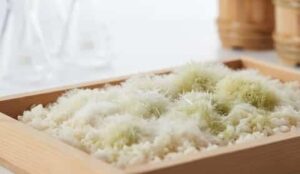
Kojic acid is a natural compound produced by certain species of fungi, particularly Aspergillus oryzae. This is the same fungus used in traditional Japanese sake (rice wine) fermentation. The compound was first discovered in 1989 as a byproduct of the fermentation process.
Unlike synthetic skin lightening agents, kojic acid occurs naturally in the fungal fermentation of rice, soy, and other grains. Today, it’s extracted and purified for use in skincare products specifically designed to treat hyperpigmentation.
How Kojic Acid Works
Kojic acid works differently from exfoliating acids like glycolic or salicylic acid. Instead of removing dead skin cells, it targets the root cause of dark spots.
The key mechanism is tyrosinase inhibition. Tyrosinase is the enzyme responsible for producing melanin in your skin. When this enzyme is active, it converts the amino acid tyrosine into melanin, which creates pigmentation. Kojic acid binds to the copper ions in tyrosinase, effectively blocking the enzyme from functioning.
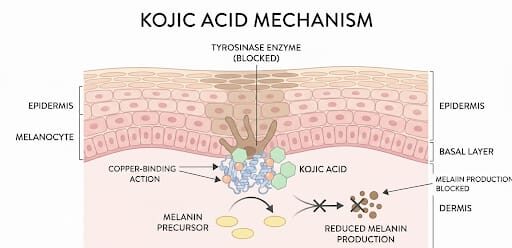
By preventing melanin production at the source, kojic acid stops new dark spots from forming while existing pigmentation gradually fades through natural skin cell turnover.
The compound also has antioxidant properties that protect skin from free radical damage, which can trigger additional pigmentation.
Kojic Acid vs Hydroquinone
Hydroquinone has long been considered the gold standard for treating hyperpigmentation, but kojic acid offers a compelling alternative.
| Feature | Kojic Acid | Hydroquinone |
| Type | Natural fungal derivative | Synthetic chemical |
| Strength | Moderate to strong | Very strong |
| Availability | Over-the-counter | Prescription for 4%+ |
| Common % | 1-4% | 2-4% (OTC), 4-12% (Rx) |
| Pregnancy | Avoid (limited data) | Avoid |
| Side Effects | Moderate irritation | Higher risk of irritation |
| Long-term Use | Safe with cycling | Ochronosis risk (rare) |
| Results Timeline | 8-12 weeks | 4-8 weeks |
Choose Kojic acid if:
- You want a natural alternative
- Hydroquinone is unavailable or too harsh for your skin
- You prefer over-the-counter options
- You’re treating moderate hyperpigmentation
Choose hydroquinone if:
- You have severe, resistant melasma
- You need faster results
- Your dermatologist recommends it
- Other treatments haven’t worked
Many dermatologists prescribe both together in combination formulas for enhanced effectiveness. The two ingredients work synergistically, with kojic acid boosting hydroquinone’s melanin-blocking power while potentially reducing side effects.
Is Kojic Acid Good for Hyperpigmentation?
ass=”alignright size-medium wp-image-972″ src=”https://wellinfinity.com/wp-content/uploads/2025/11/melasma-improvement-with-kojic-acid.jpg-e1765565332408-300×163.jpeg” alt=”Melasma patches lightening after consistent kojic acid treatment” width=”300″ height=”163″ />
Yes, kojic acid is highly effective for hyperpigmentation, particularly for stubborn cases that don’t respond well to other treatments. This makes kojic acid for melasma one of the most recommended treatments by dermatologists when gentler options haven’t worked.
Clinical studies show that kojic acid reduces hyperpigmentation by 40% to 60% after 12 weeks of consistent use at 2% to 4% concentration. It works by blocking tyrosinase activity, which prevents new melanin formation while existing dark spots gradually fade through natural cell turnover.
What sets kojic acid apart is its ability to penetrate deeper layers of skin where melanin production occurs. This makes it especially effective for melasma, which often exists in the dermal layer beyond the reach of surface exfoliants. Research published in the Journal of Dermatological Science confirms that kojic acid significantly inhibits melanogenesis with minimal cytotoxicity.
The compound is particularly valuable for treating hyperpigmentation that has proven resistant to glycolic acid, vitamin C, or other first-line treatments. Many dermatologists recommend it as a step up when gentler options haven’t delivered results.
Treats melasma effectively
Kojic acid is one of the most reliable over-the-counter treatments for melasma. It addresses both epidermal and dermal pigmentation by preventing new melanin synthesis. Most patients see noticeable improvement within 12 to 16 weeks.
Fades post-inflammatory hyperpigmentation
Dark marks left behind after acne, injuries, or inflammation respond well to kojic acid. The tyrosinase-blocking action prevents the marks from darkening further while accelerating their natural fading process.
Reduces age spots and sun damage
Years of UV exposure create concentrated areas of melanin in the skin. Kojic acid gradually lightens these spots by stopping melanin production in the affected areas. Consistent use over 8 to 12 weeks shows visible reduction in spot intensity.
Evens overall skin tone
Beyond treating specific dark spots, kojic acid creates a more uniform complexion by regulating melanin production across the entire face. This results in brighter, more luminous skin tone overall.
Provides antioxidant protection
Kojic acid scavenges free radicals that can trigger inflammation and subsequent hyperpigmentation. This antioxidant activity helps prevent new dark spots from forming while you’re treating existing ones.
Works on resistant pigmentation
When glycolic acid, azelaic acid, or vitamin C haven’t produced adequate results, kojic acid often succeeds. Its unique mechanism of directly inhibiting tyrosinase makes it effective where surface treatments fall short.
Enhances other brightening treatments
Kojic acid combines well with vitamin C, niacinamide, and even prescription hydroquinone. These combinations often produce better results than any single ingredient alone.
Research Evidence
A landmark study published in Dermatologic Surgery treated 40 women with epidermal melasma using 2% kojic acid combined with glycolic acid and hydroquinone. The results showed that 60% of patients experienced more than half of their melasma clearing on the side treated with kojic acid, compared to 47.5% on the side without kojic acid. Two patients achieved complete clearance, both on the kojic acid side.
Research in the Journal of Drugs in Dermatology evaluated a serum containing 1% kojic acid, tranexamic acid, and niacinamide in 55 Brazilian women with melasma and post-inflammatory hyperpigmentation. The 12-week study demonstrated significant improvement in skin tone evenness and hyperpigmentation with excellent tolerability and minimal side effects.
A randomized clinical trial published in PMC (PubMed Central) compared kojic acid 1% alone and in combination with hydroquinone for treating melasma in 80 patients. Kojic acid alone showed a 58.72% mean improvement in MASI scores, while the combination with hydroquinone achieved 71.87% improvement. The study confirmed kojic acid’s effectiveness as both a standalone treatment and an enhancer for other brightening agents.
A recent 2024 study in the Journal of Cosmetic Dermatology compared alpha-arbutin 5% with kojic acid 2% against triple combination cream for melasma treatment. Both treatments showed comparable effectiveness, but the kojic acid combination demonstrated lower recurrence rates after treatment cessation and fewer adverse events.
These studies consistently demonstrate that kojic acid at 1% to 4% concentrations produces measurable improvements in hyperpigmentation when used consistently for 8 to 12 weeks. The compound is particularly effective when combined with other brightening ingredients and paired with strict sun protection.
Choosing the Right Kojic Acid Percentage
Not all kojic acid products are created equal. The concentration you choose significantly impacts both results and irritation risk.
Kojic Acid Concentration Guide
| Percentage | Best For | Frequency | Product Type |
| 1-2% | Beginners, Sensitive skin, Maintenance | Daily | Serums, soaps, creams |
| 2-4% | Standard treatment, Most skin types | Daily to every other day | Serums, creams |
| 4-6% | Intensive treatment, Stubborn melasma | Every other day | Professional serums |
| Professional peels | Severe hyperpigmentation | Monthly | Dermatologist only |
Starting Safely
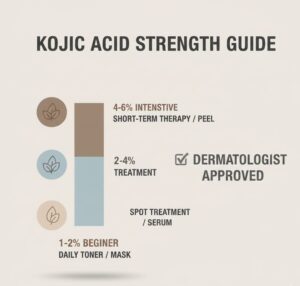
Begin with 1% to 2% kojic acid regardless of your skin type or how well you’ve tolerated other acids. Kojic acid causes more irritation than azelaic acid and similar levels to glycolic acid at comparable concentrations.
Use your starting percentage for 4 to 6 weeks before considering an increase. This gives your skin time to adapt and allows you to assess effectiveness without jumping to stronger formulations prematurely.
Product formulation matters as much as percentage. A 2% kojic acid serum will feel stronger than a 2% kojic acid soap because serums stay on your skin while soaps rinse off after brief contact.
Best Percentage by Skin Concern
For melasma: Start with 2% and increase to 4% if needed after 8 weeks. Melasma requires consistent, long-term treatment. Most people see best results staying at 2% to 4% for 12 to 16 weeks rather than jumping to higher percentages.
For post-acne marks: 1% to 3% is sufficient. Post-inflammatory hyperpigmentation responds faster than melasma, so lower percentages work well when combined with gentle exfoliation.
For age spots and sun damage: 2% to 4% concentration applied directly to spots twice daily. Targeted treatment on specific areas tolerates higher percentages better than full-face application.
For body hyperpigmentation: Kojic acid soap at 2% to 3% works well for underarms, elbows, knees, and inner thighs. Body skin is less sensitive than facial skin and responds well to wash-off formulations.
Why Product Stability Matters
Kojic acid oxidizes easily when exposed to air and light, turning brown and losing effectiveness. This is why percentage alone doesn’t guarantee results.
Look for products in opaque, airtight packaging. Dark amber or opaque white bottles protect the formula from light degradation. Pump dispensers are better than jars because they minimize air exposure.
If your kojic acid product turns yellow or brown, it has oxidized and lost potency. Replace it even if you haven’t used the entire bottle.
Some formulations use kojic acid dipalmitate, a more stable derivative. While less irritating, it’s also less effective and requires higher concentrations to match regular kojic acid results.
How to Use Kojic Acid: Step-by-Step Guide
For First-Time Users
Patch test for 48 hours
Apply a small amount to your inner forearm or behind your ear. Wait two full days. If you experience severe burning, rash, or swelling, kojic acid may be too harsh for your skin type.
Start with every other day application
Even if the patch test goes well, begin with alternate-day use for the first two weeks. This allows your skin to build tolerance gradually. Apply only at night initially.
Use the lowest available percentage
Start with 1% to 2% regardless of how resilient you think your skin is. You can always increase concentration later, but recovering from irritation takes weeks.
Monitor for sensitivity signs
Watch for persistent redness, excessive dryness, or stinging that lasts more than a few minutes. These indicate you need to reduce frequency or switch to a lower percentage.
Daily Application Method
Step 1: Cleanse thoroughly
Apply kojic acid only to completely clean, dry skin. Oil, makeup residue, or sunscreen creates a barrier that reduces effectiveness.
Step 2: Apply a thin, even layer
You need only a small amount. For facial application, a pea-sized amount covers the entire face. For targeted spots, use a cotton swab for precise application.
Step 3: No wait time required
Unlike glycolic acid, kojic acid doesn’t require a wait period before applying other products. You can immediately follow with serums or moisturizer.
Step 4: Layer with hydration
Apply a hydrating serum or moisturizer within 2 to 3 minutes. Kojic acid can be drying, so moisture replenishment is essential.
Step 5: Apply SPF 50+ every morning
This is non-negotiable. Kojic acid increases photosensitivity. UV exposure will darken existing spots and create new hyperpigmentation, completely negating your treatment progress. For kojic acid for melasma treatment, SPF 50+ with reapplication every 2 hours outdoors is absolutely critical as melasma is highly triggered by UV exposure
Kojic Acid Soap vs Serum: Which to Choose
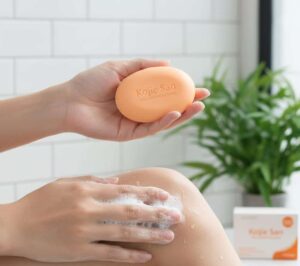
Kojic acid soap:
- Rinse-off formula with 1 to 3 minutes contact time
- Gentler option for sensitive skin
- Best for body hyperpigmentation (underarms, elbows, knees)
- Less effective for facial melasma due to short contact time
- Good for maintenance after clearing with leave-on products
Kojic acid serum:
- Leave-on formula with maximum skin contact
- More effective for facial hyperpigmentation and melasma
- Higher concentration typically (2% to 4%)
- Better absorption and deeper penetration
- Ideal for targeted treatment of stubborn spots
When to use soap: Body concerns, very sensitive facial skin, or maintenance after successful treatment with serums.
When to use serum: Active melasma treatment, facial dark spots, post-acne marks, or when you need maximum effectiveness.
How Long to Use Kojic Acid
Kojic acid works best in cycles rather than continuous long-term use.
Standard treatment cycle:
- 12 weeks of consistent use (daily or every other day)
- 4 weeks break with no kojic acid
- Resume for another 12 weeks if needed
This cycling prevents cumulative irritation and maintains effectiveness. Some people find their hyperpigmentation fully clears in one 12-week cycle. Others with stubborn melasma need two or three cycles with breaks in between.
Maintenance after clearing:
Once your hyperpigmentation has cleared, switch to kojic acid soap 2 to 3 times per week or use your serum once or twice weekly to prevent recurrence. Continue strict sun protection indefinitely.
Sample Routines
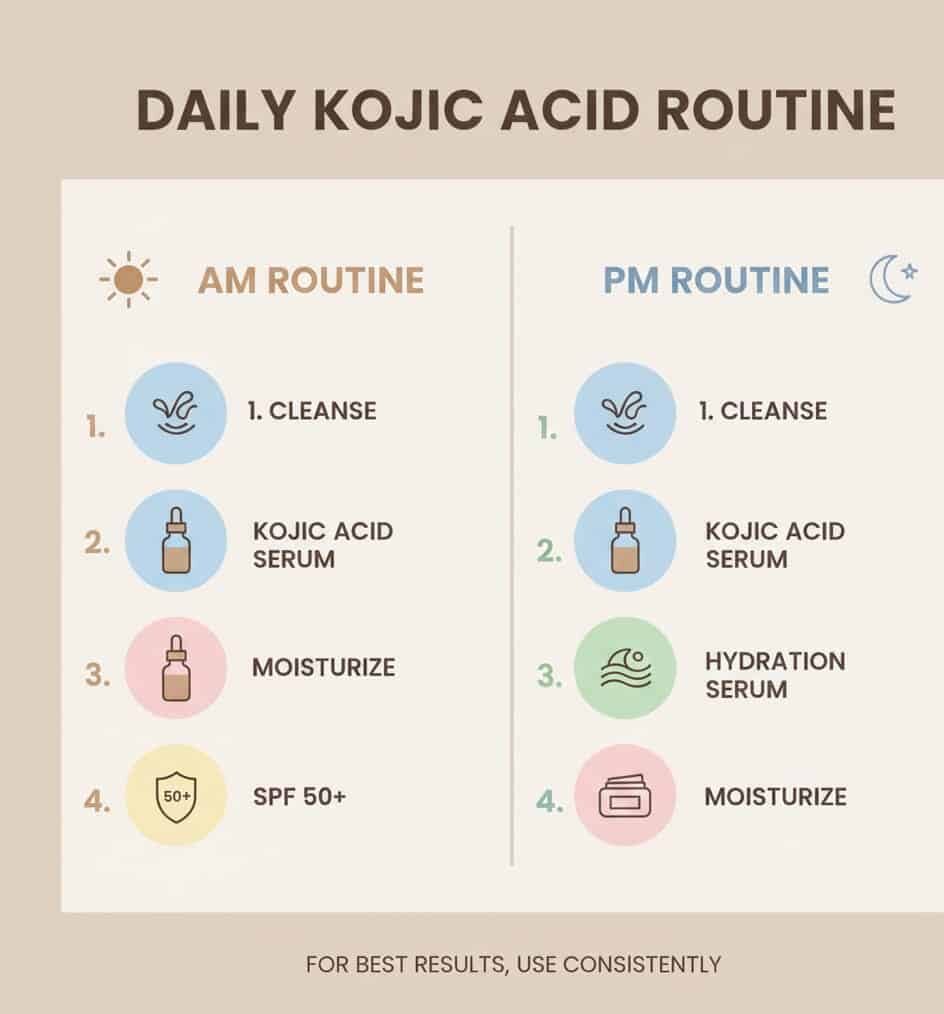
AM Routine:
- Gentle cleanser
- Kojic acid serum (if using AM)
- Niacinamide serum (optional)
- Moisturizer
- SPF 50+ sunscreen
PM Routine (Standard):
- Cleanser
- Kojic acid serum or cream
- Hydrating serum (hyaluronic acid)
- Moisturizer
- Eye cream
PM Routine (With other actives):
- Cleanser
- Kojic acid (Monday, Wednesday, Friday)
- OR Glycolic acid (Tuesday, Thursday)
- Sunday: Recovery night with only hydration
- Moisturizer every night
Common Application Mistakes
Applying to damp skin: This increases absorption too much, causing unnecessary irritation. Always apply to completely dry skin.
Using too much product: More doesn’t mean faster results. A thin layer is sufficient and reduces irritation risk.
Skipping sunscreen: UV exposure is the fastest way to reverse all progress. Missing even one day of SPF can trigger new melanin production.
Mixing with too many actives: Combining kojic acid with retinol, glycolic acid, and vitamin C all at once overwhelms your skin. Introduce one active at a time.
Expecting immediate results: Kojic acid requires 8 to 12 weeks for visible improvement. Abandoning treatment after 2 to 3 weeks means you’ll never see results.
Best Kojic Acid Products: 2025 Recommendations
When searching for the best kojic acid for melasma, look beyond percentage to formulation quality, stability, and your specific skin concerns. Choosing the right kojic acid product requires looking beyond percentage to formulation quality, stability, and your specific skin concerns. Here are the best options available in Pakistan.
Best Kojic Acid Soap: Kojie San Skin Lightening Soap
This is the most popular kojic acid soap worldwide and widely available in Pakistan. It contains 2% kojic acid in a coconut oil base that prevents excessive drying while delivering effective brightening.
The bar format makes it ideal for body hyperpigmentation on underarms, elbows, knees, and inner thighs. Many users also successfully use it on their face by creating a lather in hands and applying for 2 to 3 minutes before rinsing.
Results appear within 4 to 6 weeks for body concerns and 6 to 8 weeks for facial hyperpigmentation. The soap is gentle enough for daily use once your skin has built tolerance.
Best for: Body hyperpigmentation, dark underarms, budget-conscious shoppers, people who prefer wash-off products
Price in Pakistan: Rs. 650 to Rs. 799
Where to buy: Derma.pk, local beauty stores, online retailers
Best Kojic Acid Serum: ChiltanPure Kojic Serum
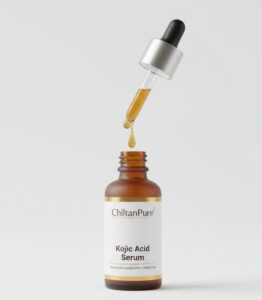
ChiltanPure is a trusted Pakistani brand offering 100% pure organic kojic acid serum. This leave-on formula provides maximum skin contact for effective treatment of melasma, dark spots, and hyperpigmentation.
The serum prevents melanin production by blocking tyrosinase enzyme activity. It absorbs quickly without leaving greasy residue, making it suitable for use under makeup or moisturizer.
The formula is free from harsh chemicals and designed specifically for Pakistani skin tones. Users report visible brightening within 4 to 6 weeks of consistent use.
Best for: Facial hyperpigmentation, melasma, post-acne marks, daily treatment
Price in Pakistan: Rs. 1,299
Where to buy: ChiltanPure.com, delivers across Pakistan (Karachi, Lahore, Islamabad, Faisalabad, Rawalpindi)
Best Kojic Acid Cream: ChiltanPure Kojic Cream
This moisturizing cream combines kojic acid with hydrating ingredients for face and body application. The cream texture works well for dry skin types and provides both brightening and moisturizing benefits.
It treats sun damage, age spots, and post-inflammatory hyperpigmentation while keeping skin soft and supple. The formula is gentle enough for sensitive skin when introduced gradually.
Apply a thin layer to clean skin once or twice daily. The cream format allows for targeted application on specific dark spots or all-over face and body use.
Best for: Dry skin, body hyperpigmentation, combination brightening and moisturizing, targeted spot treatment
Price in Pakistan: Rs. 1,099
Where to buy: ChiltanPure.com, nationwide delivery available
Best Budget Option: Local Kojic Acid Cream
Generic kojic acid creams available at local pharmacies offer affordable entry into kojic acid treatment. These typically contain 1% to 2% kojic acid and cost significantly less than branded options.
While they may lack the elegant formulations of premium products, they deliver the basic melanin-inhibiting benefits of kojic acid. They work well for testing tolerance before investing in higher-priced products.
Best for: First-time users, budget-conscious shoppers, testing skin tolerance
Price in Pakistan: Rs. 500 to Rs. 799
Where to buy: Local pharmacies, SmartHealer.pk, medical stores nationwide
Best Premium Option: Kilarca Kojic Acid Skin Lightening Soap
Kilarca offers a premium kojic acid soap formulated with Korean-based natural ingredients and Zero Pigment Light Technology. This advanced formula targets dark spots, pigmentation, and uneven skin tone more aggressively than basic soaps.
The product promises visible results within 7 days, though realistic expectations should be 2 to 4 weeks for noticeable improvement. It’s suitable for all skin types and can be used on both face and body.
The 120g bar lasts approximately 2 months with daily use. The higher price point reflects the advanced formulation and faster-acting ingredients.
Best for: Faster results, premium formulation, stubborn pigmentation, those who prefer natural Korean skincare
Price in Pakistan: Rs. 2,099 to Rs. 3,599
Where to buy: Kilarca.com, delivery within 2 to 4 working days across Pakistan
Best for DIY Formulations: Pure Kojic Acid Powder
For those who prefer making their own skincare products, pure kojic acid powder is available in Pakistan. This allows you to customize concentration (0.2% to 1.0% for cosmetic use) and combine with your preferred base ingredients.
The 50g powder can create multiple batches of serum, cream, or soap. However, this option requires knowledge of proper formulation, pH adjustment, and preservation.
Best for: DIY skincare enthusiasts, custom formulations, experienced users, cost-effective long-term option
Price in Pakistan: Rs. 150 to Rs. 800 (depending on quantity and purity)
Where to buy: Daraz.pk, AestheticDecor.pk, The Nature’s Store
Note: DIY formulations require proper knowledge. Improper mixing can lead to ineffective or irritating products.
What to Look For When Shopping
Packaging quality: Choose opaque bottles or wrapped soaps that protect kojic acid from light exposure. Clear packaging allows oxidation, reducing effectiveness.
Concentration disclosure: Reputable brands clearly state the kojic acid percentage. If not disclosed, the product likely contains ineffective amounts.
Brand reputation: In Pakistan, trusted brands like ChiltanPure, Kilarca, and international brands available through Derma.pk offer better quality control than unknown generic products.
Complementary ingredients: Products combining kojic acid with vitamin C, niacinamide, or natural extracts often work better than kojic acid alone.
Manufacturing date: Check production dates, especially for online purchases. Kojic acid products have limited shelf life once opened.
Can You Mix Kojic Acid With Other Ingredients?
Kojic Acid vs Glycolic Acid
| Feature | Kojic Acid | Glycolic Acid |
| Action | Blocks melanin production | Exfoliates dead skin cells |
| Speed | 8-12 weeks | 6-8 weeks |
| Best for | Melasma, deep pigmentation | Texture + surface pigmentation |
| Irritation | High | Medium-High |
| Sun sensitivity | High | Very High |
Choose kojic acid for: Stubborn melasma, hormonal pigmentation, melanin-blocking treatment
Choose glycolic acid for: Dull texture, fine lines, surface-level dark spots, anti-aging
Read my complete glycolic acid guide for detailed usage instructions.
How To Use Kojic Acid With Glycolic Acid?
Yes, this combination is highly effective but requires careful timing.
Method 1 (Alternating nights):
- Monday, Wednesday, Friday: Kojic acid
- Tuesday, Thursday, Saturday: Glycolic acid
- Sunday: Recovery (hydration only)
Method 2 (Same day):
- AM: Kojic acid serum
- PM: Glycolic acid toner
Start with alternating nights. Only advance to same-day use if your skin tolerates both individually without irritation.
Kojic Acid vs Azelaic Acid
Kojic acid: Stronger melanin inhibitor, more irritating, better for stubborn melasma
Azelaic acid: Gentler, pregnancy-safe, treats acne plus pigmentation, lower irritation
For complete details, see my azelaic acid guide.
How To Use Kojic Acid With Azelaic Acid?
Yes, excellent combination with complementary mechanisms.
Application: Kojic acid in AM, azelaic acid in PM. Both work through different pathways so they enhance each other without redundancy. This combination is particularly effective for kojic acid for melasma treatment as azelaic acid addresses inflammation while kojic acid blocks melanin production
This pairing suits sensitive skin better than kojic acid plus glycolic acid.
How To Use Kojic Acid With Vitamin C?
Yes, this is one of the best combinations for hyperpigmentation.
Both inhibit tyrosinase enzyme through different mechanisms. Vitamin C also provides antioxidant protection that prevents new pigmentation from forming.
Application order: Apply kojic acid first, wait 2-3 minutes, then apply vitamin C serum. Both work at similar pH levels so no conflict occurs.
Kojic Acid and Niacinamide
Safe and highly effective combination.
Niacinamide reduces inflammation, controls oil, and inhibits melanosome transfer (how melanin moves to skin cells). Kojic acid blocks melanin production. Together they attack hyperpigmentation from two angles.
Application: No special timing needed. Apply in any order within the same routine.
Kojic Acid vs Hydroquinone
Kojic acid (2-4%): Natural, over-the-counter, moderate strength, safer for long-term cycling
Hydroquinone (4% Rx): Synthetic, prescription required, very strong, risk of ochronosis with prolonged use
Combined: Often prescribed together for stubborn melasma. Requires dermatologist supervision.
Kojic Acid and Retinol
Use with extreme caution. High irritation risk.
Safe approach: Alternate nights with 48-hour gaps initially.
- Monday: Kojic acid
- Thursday: Retinol
- Sunday: Recovery
Only experienced users with resilient skin should attempt this combination.
Safe Combinations Summary
Excellent pairings:
- ✅ Vitamin C (synergistic melanin blocking)
- ✅ Niacinamide (anti-inflammatory + brightening)
- ✅ Hyaluronic acid (hydration support)
- ✅ Azelaic acid (gentle combination)
Use carefully (alternating schedule):
- ⚠️ Glycolic acid (both irritating)
- ⚠️ Retinol (high sensitivity risk)
- ⚠️ Salicylic acid (if needed for acne)
Professional supervision required:
- 🔴 Hydroquinone (prescription combination)
- 🔴 Multiple acids simultaneously
Avoid These Combinations
Never use kojic acid with benzoyl peroxide in the same routine. They neutralize each other.
Don’t combine kojic acid with multiple exfoliating acids (glycolic, lactic, salicylic) on the same day unless you have extremely resilient skin and dermatologist approval.
Avoid layering kojic acid with physical exfoliants (scrubs, brushes). Chemical treatment provides sufficient exfoliation.
Kojic Acid for Specific Skin Concerns
Kojic Acid for Melasma
It is widely considered one of the most effective over-the-counter treatments available. The compound penetrates to dermal layers where melasma pigmentation exists.
Treatment protocol:
- Use 2% to 4% kojic acid twice daily
- Combine with SPF 50+ (mandatory)
- Minimum 12 to 16 weeks for visible results
- Often paired with azelaic acid or tranexamic acid for enhanced effectiveness
Realistic expectations: 40% to 60% improvement in most cases. Complete clearance is rare. Maintenance required to prevent recurrence.
Kojic Acid for Dark Spots
Post-inflammatory hyperpigmentation and sun spots respond well to kojic acid.
Application tips:
- Use 2% to 3% concentration
- Apply directly to spots with cotton swab for targeted treatment
- Visible lightening within 6 to 8 weeks
- Combine with vitamin C for faster results
Works best on fresh dark spots (under 6 months old). Older, deeper pigmentation requires longer treatment.
Kojic Acid for Dark Underarms
Popular use case with consistent results.
How to use:
- Kojic acid soap (2% to 3%) daily after showering
- OR kojic acid cream applied at night
- Wait 24 hours after shaving before application
- Avoid deodorants with aluminum while treating
Timeline: 4 to 6 weeks for noticeable lightening. Continue for 12 weeks for maximum results.
Kojic Acid for Acne Scars
Effective only for pigmented acne marks (post-inflammatory hyperpigmentation), not textured scars.
What works:
- 2% kojic acid serum on healed acne marks
- Combine with gentle exfoliant (glycolic acid 2-3x weekly)
- Results in 8 to 12 weeks
What doesn’t work: Ice pick scars, rolling scars, boxcar scars. These require professional treatments like microneedling or laser.
Does Kojic Acid Soap Work?
Yes, but with limitations.
Advantages:
- Gentler than leave-on products
- Good for body hyperpigmentation
- Easier to incorporate into routine
- Less irritation risk
Disadvantages:
- Brief contact time (1-3 minutes) limits effectiveness
- Results take longer (8-12 weeks vs 6-8 weeks for serums)
- Less effective for facial melasma
Best use: Body concerns (underarms, elbows, knees) or facial maintenance after clearing with serums.
Kojic Acid for Body Hyperpigmentation
Effective for darkened elbows, knees, inner thighs, and neck.
Product choice: Body lotions with 2% to 3% kojic acid or daily soap use
Application: Apply after showering to damp skin for better absorption
Timeline: 8 to 12 weeks (body skin cell turnover is slower than face)
Combine with physical exfoliation once weekly to remove dead cells and enhance penetration.
Kojic Acid Side Effects and Safety
Common Side Effects
- Mild tingling or stinging during first 2-3 weeks
- Temporary redness lasting 15-30 minutes after application
- Dryness and flaking (especially week 1-3)
- Increased sun sensitivity
Signs you need to reduce frequency:
- Persistent redness lasting hours
- Excessive peeling or raw skin feeling
- Burning sensation lasting more than 5 minutes
- Worsening hyperpigmentation
- New breakouts after 4 weeks
Is Kojic Acid Safe?
Yes, when used correctly at appropriate concentrations.
Kojic acid is approved for cosmetic use in most countries at concentrations up to 4%. Japan temporarily banned it in 2003 due to contamination concerns in specific products, not the ingredient itself. The ban was lifted after safety protocols improved.
Research confirms kojic acid at 1% to 4% is safe for treating hyperpigmentation with manageable side effects. It causes more irritation than azelaic acid but similar levels to glycolic acid.
Long-term safety: Safe when used in 12-week cycles with 4-week breaks. Continuous use beyond 12 weeks increases irritation risk without additional benefits.
Can I Use Kojic Acid While Pregnant?
No, avoid kojic acid during pregnancy and breastfeeding.
Why to avoid:
- Limited safety studies on pregnant women
- Unknown effects on fetal development
- Absorption through skin enters bloodstream
- Safer alternatives exist
Pregnancy-safe alternatives:
- Azelaic acid (proven safe, FDA Category B)
- Vitamin C serum
- Niacinamide
- See my azelaic acid guide for complete pregnancy-safe treatment
Always consult your OB-GYN before using any active skincare ingredients during pregnancy.
Sun Protection (Critical)
Kojic acid increases photosensitivity significantly. UV exposure reverses all treatment progress and can worsen hyperpigmentation.
Non-negotiable rules:
- SPF 50+ every morning (even cloudy days, even indoors)
- Reapply every 2 hours if outdoors
- Wear wide-brimmed hats in direct sun
- Consider pausing treatment during beach vacations
What happens without SPF: New melanin production, darker existing spots, potential sunburn, permanent sun damage.
Who Should Avoid Kojic Acid
Do not use if you have:
- Active eczema or psoriasis
- Rosacea flares
- Open wounds or active acne lesions
- Known allergies to fungi or fermented products
- Very sensitive skin that reacts to everything
Special precautions for:
- Darker skin tones (Fitzpatrick IV-VI): Higher risk of post-inflammatory hyperpigmentation if skin gets irritated
- Those taking photosensitizing medications
- Recent cosmetic procedures (wait 2 weeks after peels, laser, microneedling)
Allergic Reactions
Rare but possible. Stop immediately if you experience:
- Hives or rash spreading beyond application area
- Severe swelling
- Difficulty breathing (seek emergency care)
- Intense burning that doesn’t subside
Contact dermatitis from kojic acid typically appears as redness, itching, and small bumps in the exact area of application.
Product Oxidation Concerns
Kojic acid oxidizes easily, turning yellow or brown. Oxidized products lose effectiveness and may increase irritation.
How to prevent:
- Store in cool, dark place
- Choose opaque packaging
- Close bottles tightly after use
- Replace if product changes color
- Use within 6 months of opening
Drug Interactions
Avoid combining with:
- Oral retinoids (Accutane/isotretinoin)
- Photosensitizing antibiotics (tetracyclines, fluoroquinolones)
Use cautiously with:
- Topical retinoids (alternate nights only)
- Other exfoliating acids
Inform your dermatologist about all medications before starting kojic acid treatment.
Kojic Acid Before and After: What to Expect
Timeline Breakdown
Week 1-2:
- Minimal visible change in pigmentation
- Possible initial irritation (redness, tingling)
- Skin adjusting to treatment
Week 3-4:
- Slight overall brightening
- Dark spots still prominent
- Reduced irritation as tolerance builds
Week 6-8:
- Noticeable lightening of dark spots begins
- Skin tone appears more even
- This is when most people see first real improvement
Week 10-12:
- Significant improvement visible
- Post-acne marks 50-60% lighter
- General hyperpigmentation markedly reduced
Week 16+:
- Maximum results for melasma (40-60% improvement)
- Maintenance phase begins
- Switch to 2-3x weekly application
Realistic Expectations
Kojic acid is not a miracle cure. Complete disappearance of all pigmentation is rare, especially for melasma or deep sun damage.
Most users achieve 40% to 70% reduction in hyperpigmentation with consistent 12-week treatment. Remaining pigmentation often fades with continued maintenance or requires combining with other treatments.
Results depend on:
- Pigmentation depth and age
- Consistency of application
- Sun protection adherence
- Skin type and sensitivity
- Combining with other actives
Maintenance is essential. Hyperpigmentation returns if treatment stops and sun protection lapses.
Kojic Acid vs Other Brightening Ingredients
Complete Comparison Table
| Ingredient | Kojic Acid | Glycolic Acid | Azelaic Acid | Vitamin C | Hydroquinone |
| Mechanism | Tyrosinase inhibitor | Exfoliates surface cells | Multi-action | Antioxidant + tyrosinase blocker | Melanin bleaching |
| Strength | Strong | Medium-High | Gentle | Medium | Very Strong |
| Best For | Melasma, stubborn spots | Texture + pigmentation | Acne + PIH | Prevention, glow | Severe pigmentation |
| Speed | 8-12 weeks | 6-8 weeks | 8-12 weeks | 8-12 weeks | 4-8 weeks |
| Irritation | High | Medium-High | Very Low | Low | Medium-High |
| Pregnancy | ❌ Avoid | Low % only | ✅ Safe | ✅ Safe | ❌ Avoid |
| OTC/Rx | OTC | OTC | OTC | OTC | Rx (4%+) |
| Stability | Low (oxidizes) | High | High | Low (oxidizes) | Medium |
| Sun Sensitivity | High | Very High | Low | Low | High |
Quick Decision Guide
Start with kojic acid if:
- You have stubborn melasma not responding to gentler options
- Post-acne marks persist after 3+ months
- You want strong melanin-blocking action
- You’re not pregnant or breastfeeding
Choose Kojic acid for melasma treatment or hydroquinone (Rx) if:
- Severe melasma not responding to OTC options
- Dermatologist recommends it
- You need fastest possible results
- You’re under medical supervision
Best Combinations for Stubborn Pigmentation
Effective pairings:
- Kojic acid (AM) + Azelaic acid (PM)
- Kojic acid + Vitamin C (same routine)
- Kojic acid + Niacinamide (synergistic)
- Kojic acid (3x weekly) + Glycolic acid (2x weekly)
Professional combination:
- Kojic acid + Hydroquinone (dermatologist supervision only)
Conclusion: Is Kojic Acid Right for Your Skin?
Kojic acid for melasma is one of the most powerful over-the-counter treatments, especially for stubborn hyperpigmentation that hasn’t responded to gentler options. When used at 2% to 4% concentration with consistent application and strict sun protection, most people see 40% to 60% improvement within 12 weeks.
Start with 1% to 2% kojic acid applied every other night. Build tolerance over 2 to 3 weeks before increasing frequency. Always wear SPF 50+ daily, as UV exposure reverses all progress. Cycle your treatment in 12-week periods with 4-week breaks to prevent irritation. For comprehensive brightening results, combine kojic acid with vitamin C or niacinamide, or alternate nights with glycolic acid for enhanced effectiveness.
If you’re comparing different acids or want gentler alternatives, read my complete guides on glycolic acid for hyperpigmentation and azelaic acid benefits. Each acid has unique strengths, and understanding how they work together helps you create the most effective treatment plan for your specific skin concerns.
Frequently Asked Questions
What is kojic acid?
Kojic acid is a natural compound derived from mushroom fungi, particularly from the fermentation of rice used in sake production. It works as a tyrosinase inhibitor, blocking the enzyme responsible for melanin production in skin. This makes it highly effective for treating melasma, dark spots, and hyperpigmentation.
Is kojic acid good for hyperpigmentation?
Yes, kojic acid is highly effective for hyperpigmentation. Clinical studies show 40% to 60% improvement in dark spots after 12 weeks of consistent use at 2% to 4% concentration. It works particularly well for melasma, post-inflammatory hyperpigmentation, and stubborn spots that don’t respond to gentler treatments.
Kojic acid vs hydroquinone: which is better?
Hydroquinone is stronger and works faster (4-8 weeks) but requires prescription for concentrations above 2% and carries risk of ochronosis with prolonged use. Kojic acid is natural, available over-the-counter, and safer for long-term cycling but takes longer (8-12 weeks). Many dermatologists prescribe both together for stubborn melasma.
How long does kojic acid take to work?
Visible brightening appears in 6 to 8 weeks. Significant improvement in dark spots occurs at 10 to 12 weeks. Melasma requires 12 to 16 weeks minimum for noticeable results. Consistency is critical. Missing applications significantly delays progress.
Can I use kojic acid while pregnant?
No, avoid kojic acid during pregnancy and breastfeeding due to limited safety data. Safer alternatives include azelaic acid (FDA Category B, proven safe), vitamin C, and niacinamide. Always consult your OB-GYN before using any active skincare ingredients during pregnancy.
Does kojic acid soap work?
Yes, but slower than leave-on serums due to brief contact time (1-3 minutes). Kojic acid soap works well for body hyperpigmentation like dark underarms, elbows, and knees. Results take 8 to 12 weeks with daily use. For facial melasma, serums or creams are more effective.
Can you use kojic acid with glycolic acid?
Yes, this is a powerful combination when used carefully. Alternate nights (kojic acid Monday/Wednesday/Friday, glycolic acid Tuesday/Thursday/Saturday) or use kojic acid in morning and glycolic acid at night. Both are irritating, so start conservatively and monitor for over-exfoliation signs.
Can you use kojic acid with vitamin C?
Yes, excellent pairing. Both inhibit tyrosinase through different mechanisms, creating synergistic brightening effects. Apply kojic acid first, wait 2-3 minutes, then apply vitamin C serum. Both work at similar pH levels so no conflict occurs.
Is kojic acid safe for daily use?
Yes, at 1% to 2% concentration once your skin has built tolerance. Start with every other day for first 2-3 weeks. Higher concentrations (3-4%) should be used every other day maximum. Use in 12-week cycles with 4-week breaks to prevent cumulative irritation.
What percentage of kojic acid is effective?
1% to 2% for beginners and maintenance. 2% to 4% for standard treatment of melasma and hyperpigmentation. 4% to 6% for intensive treatment of stubborn pigmentation under dermatologist guidance. Professional peels use higher concentrations but require medical supervision.
Can I use kojic acid on my underarms?
Yes, kojic acid is highly effective for dark underarms. Use 2% to 3% kojic acid soap daily or apply kojic acid cream at night. Wait 24 hours after shaving before application. Results appear in 4 to 6 weeks with consistent use and proper sun protection.
Does kojic acid lighten skin permanently?
No, results are not permanent. Hyperpigmentation returns if treatment stops and sun protection lapses. Kojic acid blocks new melanin production, but UV exposure, hormones, and inflammation can trigger pigmentation to return. Maintenance application 2-3x weekly and daily SPF 50+ are essential.
Can you use kojic acid with niacinamide?
Yes, safe and highly effective combination. Niacinamide reduces inflammation and inhibits melanosome transfer while kojic acid blocks melanin production. No special timing needed. Apply in any order within the same routine for enhanced brightening results.
Is kojic acid safe for dark skin?
Yes, but requires extra caution. Darker skin tones (Fitzpatrick IV-VI) have higher risk of post-inflammatory hyperpigmentation if skin becomes irritated. Start with 1% concentration, patch test thoroughly, and increase frequency very gradually. Any irritation can worsen hyperpigmentation in darker skin.
Can you use kojic acid with retinol?
Use with extreme caution due to high irritation risk. Alternate nights with 48-hour gaps initially (kojic acid Monday, retinol Thursday). Only experienced users with resilient skin should attempt this combination. Signs of over-exfoliation mean immediate reduction in frequency.
How to store kojic acid products?
Store in cool, dark place away from sunlight. Keep bottles tightly closed to minimize air exposure. Choose products in opaque packaging (amber or white bottles). Replace if product turns yellow or brown, indicating oxidation and loss of potency. Use within 6 months of opening.
Does kojic acid work on acne scars?
Yes, but only on pigmented acne marks (post-inflammatory hyperpigmentation), not textured scars. Apply 2% kojic acid to healed marks for 8 to 12 weeks. For ice pick scars, rolling scars, or boxcar scars, professional treatments like microneedling or laser are required.
Is kojic acid better than azelaic acid?
Depends on your concern. Kojic acid is stronger for pure pigmentation (melasma, dark spots) but more irritating. Azelaic acid is gentler, treats both acne and pigmentation, and is pregnancy-safe. For sensitive skin or acne plus dark spots, choose azelaic acid. For stubborn melasma, choose kojic acid.
Can kojic acid remove dark spots completely?
Not always. Most users achieve 40% to 70% reduction in hyperpigmentation with 12-week treatment. Complete removal depends on spot depth, age, and type. Fresh spots (under 6 months) respond better. Very deep dermal pigmentation may only partially fade and require professional treatments.
Kojic acid or hydroquinone for melasma?
Both are effective. Hydroquinone works faster (4-8 weeks) but requires prescription and medical supervision. Kojic acid takes longer (12-16 weeks) but is available over-the-counter and safer for long-term use. Many dermatologists combine both for enhanced results in stubborn melasma cases.
Is kojic acid good for melasma?
Yes, kojic acid for melasma is one of the most effective over-the-counter treatments. It penetrates to dermal layers where melasma pigmentation exists and blocks tyrosinase enzyme activity. Clinical studies show 40% to 60% improvement after 12 to 16 weeks of consistent use at 2% to 4% concentration combined with SPF 50+.
📚 Related Reading
→ Glycolic Acid for Hyperpigmentation: Complete Guide – Fast-acting exfoliant for texture and pigmentation
→ Azelaic Acid Complete Guide – Gentle, pregnancy-safe alternative for acne and dark spots