
7 Postpartum Hair Loss Mistakes That Can Make Shedding Worse
You expected the sleepless nights. You expected the emotional rollercoaster. But clumps of hair clogging the shower drain, stray strands on every pillow, and a visibly thinning hairline? That part nobody warns you about clearly enough.
Postpartum hair loss, clinically known as telogen effluvium, affects nearly 40 to 50% of new mothers, according to Johns Hopkins Medicine. It typically starts around two to four months after delivery and peaks around months four to six. For most women, hair returns to its previous fullness by the baby’s first birthday.
Certain postpartum hair loss mistakes can actively prolong the shedding, damage fragile regrowth, and turn a temporary condition into one that stretches far longer than it should. Some of these habits are things well-meaning new moms do out of desperation to fix the problem, and they’re quietly making it worse.
This guide breaks down the seven most common mistakes, what the research says, and exactly what to do instead.
Quick Signs This Is Normal Postpartum Shedding
✓ Starts 2–4 months after delivery
✓ Hair falls diffusely, not in patches
✓ Peaks around months 4–6
✓ Mostly affects scalp, not eyebrows
✓ Usually improves within 12 months
What Actually Causes Postpartum Hair Shedding
The hair growth cycle operates in three distinct phases. The anagen phase is active growth, lasting two to six years. This is where 85 to 90% of your follicles sit at any given time. The catagen phase is a brief transitional period. The telogen phase is resting and shedding, lasting roughly three months. When that cycle is disrupted on a large scale, dramatic shedding follows.
During pregnancy, rising estrogen (and to a lesser extent, progesterone) extends the anagen phase of each hair follicle. The result is the lush, thick pregnancy hair many women appreciate. After delivery, estrogen and progesterone drop sharply. That sudden hormonal withdrawal signals a large number of follicles to shift simultaneously into the telogen phase. According to the Cleveland Clinic, up to 30% of follicles can enter this resting phase at once, compared to the normal 10 to 15%. A few months later, all that resting hair sheds together, producing the dramatic diffuse shedding typical of postpartum telogen effluvium.
The follicles are not damaged. They’re cycling. But several common postpartum hair loss mistakes can extend that shedding window, worsen visible thinning, and impair regrowth. That’s the part within your control.
Postpartum Hair Loss Timeline
Timeline What Happens Pregnancy Hair stays in growth phase 2–4 Months Postpartum Shedding begins 4–6 Months Peak hair fall 6–12 Months Gradual regrowth 12+ Months See doctor if no improvement
Mistake 1: Stopping Your Prenatal Vitamins Too Soon
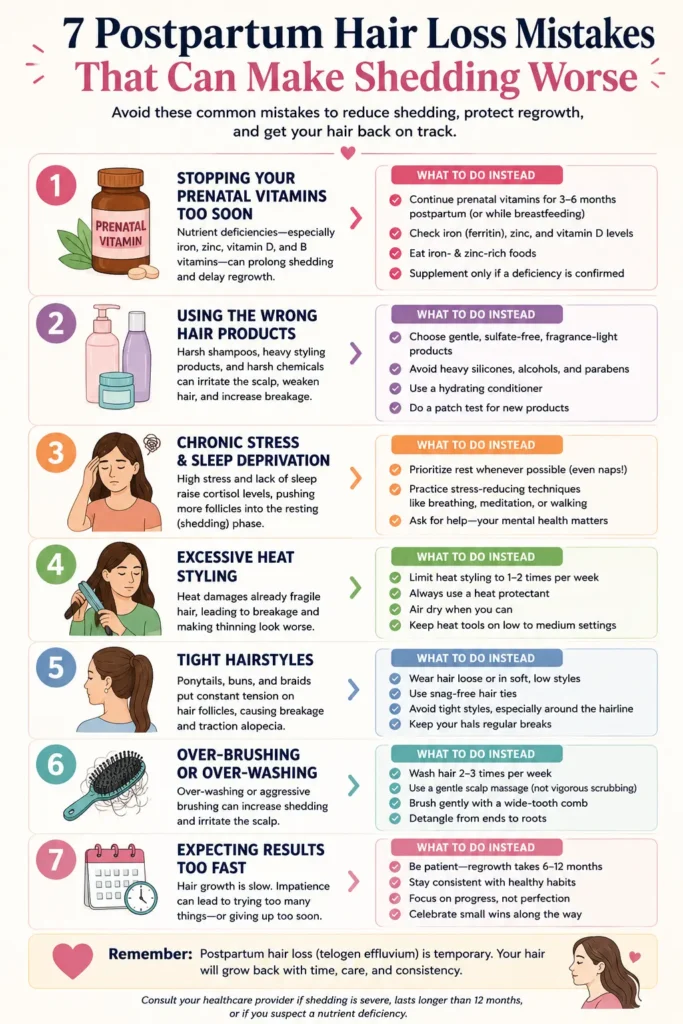
This is one of the most widespread postpartum hair loss mistakes, and it’s easy to understand why it happens. Once the baby arrives, the prenatal vitamin bottle quietly gets forgotten.
Your body’s nutritional demands don’t drop after delivery. If you’re breastfeeding, they’re often higher. According to the American Academy of Dermatology, the body prioritizes milk production over non-essential functions including hair follicle health during the postpartum period. Key nutrients, specifically iron, zinc, vitamin D, and B vitamins, become depleted faster than diet alone can replace them, especially following significant blood loss during delivery.
Ferritin deficiency is particularly significant here. Ferritin is the protein that stores iron in the body, and low ferritin levels are consistently linked to prolonged telogen effluvium, even when standard hemoglobin tests appear normal.
What to do instead:
- Continue prenatal vitamins for at least 3 to 6 months postpartum, or for as long as you’re breastfeeding
- Ask your doctor for a full iron panel including ferritin, not just a CBC, if shedding seems excessive
- Prioritize iron-rich foods: lean meat, lentils, spinach, pumpkin seeds, fortified cereals
- Ensure adequate zinc through diet (meat, shellfish, nuts, seeds) or targeted supplementation if deficient
- Get vitamin D levels checked, as supplementation is often warranted postpartum
For a deeper look at how biotin specifically fits into the postpartum picture, see our guide on biotin for postpartum hair loss.
The Biggest Postpartum Hair Loss Mistakes
✓ Stopping prenatals too early
✓ Tight hairstyles
✓ Crash dieting
✓ Excess heat styling
✓ Ignoring iron deficiency
✓ Using harsh products
✓ Stress-checking hair constantly
Mistake 2: Using the Wrong Hair Products
When shedding starts, many new moms reach for products marketed as “hair growth” or “thickening” without checking what’s actually inside. Some contain sulfates, harsh alcohols, or heavy silicones that strip the scalp, clog follicles, or weigh down fine regrowth.
Scalp inflammation is an underappreciated factor in postpartum hair recovery. Certain shampoo ingredients, particularly sodium lauryl sulfate (SLS) in high concentrations, can irritate the scalp barrier. The American Academy of Dermatology notes that scalp health is directly tied to hair health, and conditions that cause scalp irritation can worsen the rate and appearance of shedding.
Conditioners applied directly to the roots are a subtle but real issue. They flatten fragile regrowth and cause product buildup at the scalp. Heavy oils used directly on the scalp can block follicle openings when overapplied, potentially prolonging the transition from telogen back to anagen.
What to do instead:
- Use a volumizing, sulfate-free shampoo formulated for thinning or fine hair
- Apply conditioner only to the mid-lengths and ends, not at the scalp or roots
- Look for scalp-supportive ingredients: niacinamide (reduces scalp inflammation), caffeine (may help extend the anagen phase topically), and zinc pyrithione for scalp health
- Avoid heavy oils applied directly to the scalp
- Wash regularly, as product and oil buildup can exacerbate scalp irritation and worsen shedding
If you’re unsure how to structure a hair care routine that supports regrowth, our guide on building a biotin hair care routine combining oil, shampoo, and diet lays out a practical framework.
Mistake 3: Wearing Tight Hairstyles During the Shedding Phase
This postpartum hair loss mistake has direct clinical documentation. Research published on PMC found that postpartum telogen effluvium can unmask underlying traction alopecia.
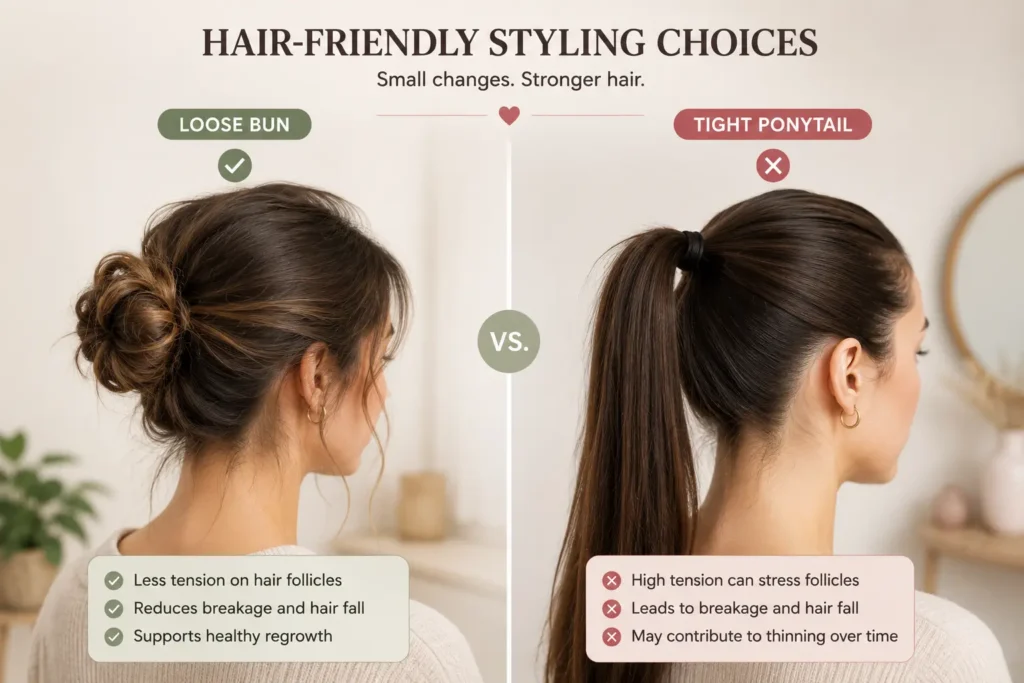
The mechanism is straightforward. When follicles are already in a vulnerable shedding phase, repeated pulling from tight ponytails, buns, braids, sew-ins, or extensions adds additional physical stress to the roots. What begins as temporary hormonal shedding can progress to traction alopecia, particularly at the temples and hairline.
⚠️ This is particularly important for women who wore protective styles regularly before or during pregnancy. The postpartum period is not the time to default to these styles as a low-maintenance solution.
What to do instead:
- Choose loose, low-manipulation styles during peak shedding months (months 3 to 6 postpartum)
- Use soft scrunchies or claw clips rather than tight elastic bands
- If braids or sew-ins are necessary, ensure tension at the hairline is minimal and take breaks between styles
- If bare patches form specifically at the temples or hairline, see a dermatologist promptly, as this may indicate traction alopecia rather than standard postpartum shedding.
Mistake 4: Applying Excess Heat to Already Fragile Hair
Heat styling during postpartum hair loss creates a compounding problem. High heat directly damages weakened hair shafts, causing breakage that mimics and amplifies the appearance of shedding. Heat exposure to an already-stressed scalp can also worsen the follicular microenvironment.
Many new moms use heat styling out of simple time pressure. This shows up as apparent hair loss even when it’s structural damage rather than follicle shedding, and that distinction matters because breakage responds to different interventions than telogen shedding.
The Cleveland Clinic specifically advises using lower heat settings on blow dryers and styling irons to prevent further damage during the postpartum recovery period.
What to do instead:
- Air dry whenever possible; use a microfiber towel rather than terrycloth, which creates friction breakage
- If blow drying, use the cool or low heat setting and keep the dryer at least 6 inches from the scalp
- Set flat irons and curling wands to the lowest effective temperature. For fine or fragile hair, 300°F or below is a reasonable ceiling
- Apply a heat protectant spray before any heat tool use without exception
These hair care principles tie into a broader conversation about what actually works for hair growth. For an evidence-based breakdown, see does biotin actually help hair growth?
Mistake 5: Crash Dieting or Severely Restricting Calories Postpartum
The pressure to lose pregnancy weight is relentless. But aggressive caloric restriction is one of the most damaging postpartum hair loss mistakes because it directly and measurably extends the shedding timeline.
When the body senses a significant energy deficit, it reallocates resources away from non-critical functions. The hair growth cycle is consistently among the first systems deprioritized. The anagen phase shortens, more follicles shift into telogen simultaneously, and shedding intensifies or persists beyond what the hormonal trigger alone would have caused.
According to Johns Hopkins Medicine, nutritional deficiencies in postpartum women, especially those breastfeeding, directly weaken hair fiber and slow regrowth.
Best Foods for Postpartum Hair Regrowth
✓ Eggs
✓ Lentils
✓ Salmon
✓ Pumpkin seeds
✓ Greek yogurt
✓ Spinach
✓ Lean red meat
What to do instead:
- Do not drop below maintenance calories while breastfeeding. Your nutritional needs are increased, not decreased
- Aim for at least 50 to 60 grams of protein daily (higher if breastfeeding), distributed across meals
- Prioritize protein-dense whole foods: eggs, legumes, fatty fish, poultry, Greek yogurt
Eating for hair regrowth doesn’t require complicated supplements. Many of the most effective nutrients come from whole foods. Our list of top biotin-rich foods for hair growth is a practical starting point.
Mistake 6: Ignoring Thyroid or Iron Issues Because “It’s Just Postpartum”
This is arguably the most medically significant of all postpartum hair loss mistakes.
Postpartum thyroiditis, inflammation of the thyroid gland following delivery, occurs in over 10% of new mothers. It can cause hair loss that looks identical to standard telogen effluvium but has a different underlying cause and requires different management.
The thyroid directly influences the hair growth cycle through thyroid hormone receptors in follicle cells. Both hypothyroidism and the transient hyperthyroid phase of postpartum thyroiditis can trigger or extend shedding. One of the most telling signs of thyroid involvement, often overlooked, is thinning of the outer third of the eyebrows.
Symptoms that suggest thyroid involvement include:
- Thinning of the outer third of the eyebrows (a hallmark sign of hypothyroidism)
- Persistent fatigue, unexplained weight changes, feeling persistently cold
- Constipation, dry skin, difficulty concentrating, or mood disturbances
- Hair loss that begins later than typical (after month six) or worsens rather than improving
Ferritin deficiency, which means low stored iron, is the other frequently missed contributor. A standard CBC blood test can return completely normal results while ferritin is critically depleted. Research consistently links ferritin below 30 µg/L to telogen effluvium, independent of hemoglobin levels. Women who experienced significant blood loss during delivery are at particular risk and should request ferritin testing specifically.
According to the American Academy of Dermatology, if hair does not regain its normal fullness within one year postpartum, underlying conditions such as iron deficiency or thyroid disease should be formally investigated.
What to do instead:
- If shedding continues past six months, request a full thyroid panel (not just TSH, but free T3, free T4, and thyroid antibodies) alongside an iron panel including ferritin
- Do not rely on a CBC alone to rule out iron deficiency
- Note eyebrow thinning, temperature sensitivity, or mood changes and share them specifically with your provider
- If hair loss is concentrated at the temples and crown rather than diffuse, ask about androgenic alopecia
Supporting your overall hormonal health during this period is foundational. If hormonal imbalances are a recurring concern for you, it’s also worth understanding how conditions like PCOS interact with hair loss. Our guide on biotin for PCOS covers the nuances.
Mistake 7: Panicking and Over-Manipulating the Hair
When new moms notice significant shedding, a common response is compulsive checking: running fingers through the hair, brushing vigorously to gauge how much is coming out, washing more frequently out of anxiety.
Over-manipulation doesn’t cause additional follicle damage in the clinical sense, but it accelerates the visible output of hairs already destined to shed. This creates a distressing feedback loop: checking leads to seeing more hair, which leads to more anxiety, which leads to more checking.
Prolactin, elevated during breastfeeding, can also interact with cortisol (the stress hormone) in ways that modestly influence the hair cycle. Adding hair-loss anxiety on top of this load isn’t neutral.
According to Johns Hopkins Medicine, managing stress through available support systems, such as talking to a doctor, family, or peer support groups, can help reduce the stress component that exacerbates postpartum shedding.
What to do instead:
- Brush gently once or twice daily with a wide-tooth comb or soft-bristle brush
- Always detangle starting from the ends and working upward. Never drag through tangles from root to tip
- Avoid compulsive counting or visual checking of shed hairs
- If postpartum anxiety is significant, address it directly through therapy, peer support, or your provider. This benefits both mental health and hair recovery simultaneously
When to See a Dermatologist
Most postpartum hair shedding resolves without intervention within six to twelve months. But certain signs indicate something more specific is happening and warrants professional evaluation:
- ✓ Shedding that continues past twelve months without improvement
- ✓ Patchy, defined bald spots rather than diffuse thinning (may indicate alopecia areata)
- ✓ Temple or hairline hair loss that doesn’t recover after the main shedding phase resolves
- ✓ Shedding accompanied by scalp pain, burning, or itching (may indicate scalp inflammation or scarring alopecia)
- ✓ Eyebrow or eyelash thinning alongside scalp loss (thyroid red flag)
- ✓ Any symptoms suggesting thyroid dysfunction or ferritin deficiency
Treatments like PRP (platelet-rich plasma) therapy or minoxidil may be appropriate in select cases, but should be recommended by a clinician based on your specific presentation.
Frequently Asked Questions
How long does postpartum hair loss typically last?
Postpartum hair shedding usually begins two to four months after delivery and resolves within six to twelve months. According to the American Academy of Dermatology, most women regain their normal hair growth by their child’s first birthday. The timeline varies based on hormonal recovery speed, nutritional status, breastfeeding duration, and whether any underlying conditions like postpartum thyroiditis or ferritin deficiency are present.
Does breastfeeding make postpartum hair loss worse?
Breastfeeding can extend the shedding phase for some women because hormonal shifts, including elevated prolactin levels, continue throughout lactation and delay full estrogen recovery. Breastfeeding also significantly increases nutritional demands. The body prioritizes milk production over hair follicle health, which can deplete iron, zinc, and vitamin D faster than diet replaces them. Targeted nutrition while breastfeeding is one of the most practical steps to support hair recovery.
Can biotin supplements stop postpartum hair loss?
Biotin supports hair growth primarily when there’s an actual deficiency, which is relatively uncommon in women eating a reasonably balanced diet. For most postpartum women, supplementing beyond what’s needed has limited evidence of benefit for typical telogen effluvium. High-dose biotin (above 5,000 mcg) can also interfere with thyroid function blood tests, producing falsely abnormal results. Always inform your provider if you’re taking biotin before having blood work done, particularly thyroid panels. For a complete picture of what biotin can and can’t do postpartum, read our full guide on biotin for postpartum hair loss.
Can low iron cause postpartum hair loss?
Yes, and this is one of the most underdiagnosed contributors to prolonged postpartum shedding. Ferritin deficiency (low stored iron) is consistently associated with telogen effluvium even when standard blood counts appear completely normal. Women who experienced significant blood loss during delivery are at particular risk. Symptoms of iron deficiency alongside hair loss include fatigue, pale skin, dizziness, difficulty concentrating, and shortness of breath. Ask your provider specifically for a full iron panel that includes ferritin. A level below 30 µg/L warrants attention even if hemoglobin is within normal range.
What vitamins help postpartum hair regrowth?
The nutrients most directly linked to hair follicle health and regrowth in postpartum women are iron (specifically ferritin levels), zinc, vitamin D, and B vitamins including B12 and biotin. Omega-3 fatty acids support the scalp’s inflammatory balance and follicle environment. Protein is equally essential, since hair fiber is composed of keratin. The most effective approach is to test for actual deficiencies rather than supplementing blindly. A comprehensive nutrient panel can identify where your body’s stores are genuinely depleted and guide targeted supplementation. If you’re considering biotin specifically, our guide on how much biotin you should take daily covers safe dosage ranges for postpartum and breastfeeding women.
Can postpartum hair loss affect eyebrows?
Standard postpartum telogen effluvium affects the scalp diffusely and does not typically cause significant eyebrow thinning. If you notice the outer third of your eyebrows becoming sparse or disappearing alongside scalp hair loss, this is a recognized clinical sign of hypothyroidism, not typical postpartum shedding. Postpartum thyroiditis, which occurs in over 10% of new mothers, commonly presents this way. Eyebrow thinning warrants a full thyroid panel including TSH, free T3, free T4, and thyroid antibodies rather than simply waiting out the postpartum period.
How do I know if my postpartum hair loss is thyroid-related?
Thyroid-related hair loss tends to look different from standard postpartum telogen effluvium in several ways. It often begins later (after month six rather than months two to four), may worsen rather than gradually improve, and frequently comes alongside other symptoms including persistent fatigue, feeling cold all the time, unexplained weight changes, dry skin, constipation, brain fog, or mood disturbances.
Thinning of the outer third of the eyebrows is particularly telling. Postpartum thyroiditis can also cause a temporary hyperthyroid phase first, followed by hypothyroidism, so symptoms may shift over time.
Is it normal to see bald patches during postpartum hair loss?
Diffuse thinning across the entire scalp is the hallmark of postpartum telogen effluvium. It’s visible and sometimes alarming, but spread out rather than concentrated. Clearly defined bald patches are not typical of standard postpartum shedding and may indicate alopecia areata (an autoimmune condition affecting follicles) or, if located specifically at the temples and hairline, traction alopecia from tight hairstyles. Both conditions require professional evaluation; alopecia areata in particular can be treated effectively when caught early.
What’s the difference between postpartum hair loss and regular hair shedding?
Normal daily shedding is 50 to 100 hairs. During postpartum telogen effluvium, daily shedding can exceed 300 hairs, producing visible clumps in the shower drain, on pillows, and throughout clothing. The shedding is diffuse rather than patchy and typically most dramatic around months four to six postpartum before gradually tapering. If shedding is concentrated in specific areas, involves defined bald patches, or comes with scalp symptoms like itching or burning, it may not be standard postpartum shedding and warrants dermatological evaluation.
Can stress alone cause postpartum hair loss?
Psychological and physical stress are both documented triggers for telogen effluvium. The postpartum period involves considerable combined stress, including sleep deprivation, hormonal fluctuations, labor recovery, and major lifestyle changes. Elevated cortisol can disrupt the hair growth cycle by pushing follicles prematurely into the telogen (resting) phase. Managing stress through sleep, support systems, and mental health care isn’t just good for wellbeing. It directly supports a shorter shedding timeline and more efficient regrowth.
The Bottom Line
Postpartum hair loss is temporary and hormonally driven. You cannot fully prevent it, and you don’t need to panic. What you can do is avoid the postpartum hair loss mistakes that unnecessarily extend the shedding window: stopping prenatal vitamins early, wearing tight hairstyles, using the wrong products, crash dieting, applying excess heat, and dismissing signs of treatable conditions like ferritin deficiency, postpartum thyroiditis, or androgenic alopecia.
Be patient with your body. It just did something remarkable. With consistent, gentle care, adequate nutrition, low-manipulation hair handling, and timely medical attention when something feels off, most women recover full hair density within a year.
If you’re weighing your supplement options and wondering what actually moves the needle, our comparison of biotin vs collagen for hair and nails is a useful next read.
Medical Disclaimer:
This article is for informational purposes only and does not constitute medical advice. It is not a substitute for professional medical diagnosis or treatment. Consult a licensed dermatologist if you notice persistent or unusual nail changes.
About the Author
Syma Hussain | Women’s Health and Beauty Writer, wellInfinity.com
Syma Hussain is the founder and lead writer at WellInfinity, a holistic health platform empowering women through research-backed wellness advice. After years of navigating her own skin and nail health challenges, she turned her personal experience into a resource that cuts through generic advice and delivers what actually works.